
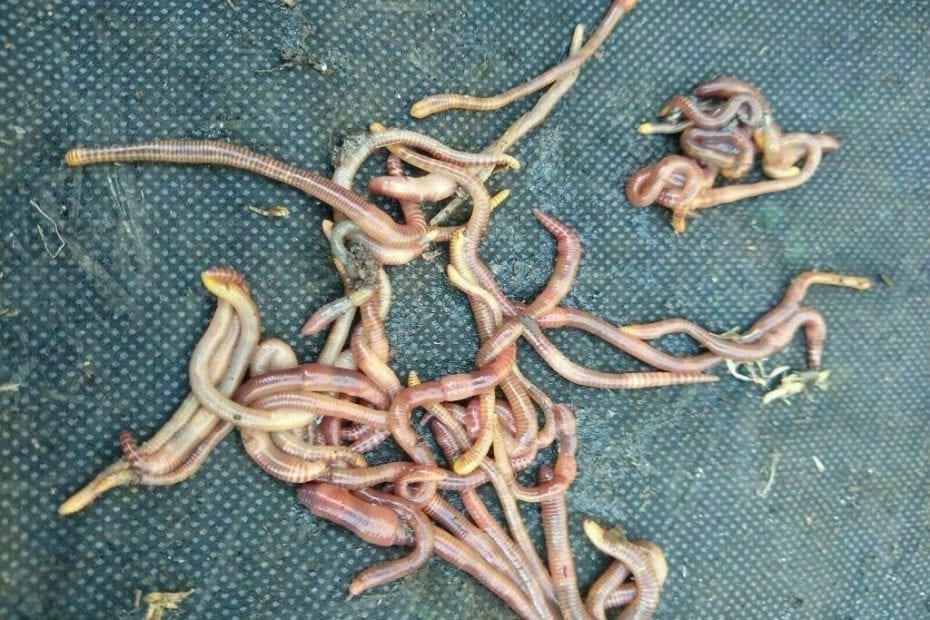
If you notice tiny seed-shaped capsules in a red wiggler bin, you may be looking at cocoons. They are part of the worms’ normal reproductive cycle, and spotting one is a useful sign that the habitat has supported reproduction. It does not, by itself, tell you how many young will hatch or how many worms the bin contains.

What a red wiggler cocoon looks like
Red wiggler cocoons are small, oval capsules, roughly the size and shape of a grape seed. They start pearly yellow and become darker brown as development proceeds, according to North Carolina State University Extension. In damp bedding, they can be easy to miss among bits of food, castings, and fibers. A pale or brown capsule is a clue, but color alone cannot confirm that it is viable or predict exactly when it will hatch.
How the cocoon forms
Earthworms are hermaphrodites: an individual has both male and female reproductive organs, though mating involves two worms exchanging sperm. The clitellum, the thicker band visible on a mature worm, secretes a ring of material. As the ring moves forward over the worm, it receives eggs and sperm; the ring then slips off and closes into a cocoon in the bedding. Fertilization and early development take place inside that capsule.
That is why cocoons are not loose clusters of eggs. They are protective capsules deposited into the surrounding substrate. You do not need to handle them to support the process.
How long until they hatch?
There is no single dependable countdown for every bin. NC State Extension gives a range of about 30 to 75 days for Eisenia fetida, with roughly three young per cocoon, while emphasizing that species and environmental conditions matter. A study by Venter and Reinecke reported an average incubation of 23 days and 2.7 hatchlings per cocoon under favorable cattle-manure conditions. Those numbers describe different conditions; they are not a promise for a home or classroom bin.
Temperature, moisture, aeration, and food all shape worm activity and development. Keep bedding moist and crumbly rather than waterlogged, and continue the routine care that is working for the bin. If you find a cocoon, leave it in place; digging repeatedly or transferring it to a separate container adds disturbance without a clear benefit.
A simple observation for home or class
For a gentle observation, examine a small amount of bedding over a light-colored tray, then return it promptly. Record where you found any capsules, their approximate size and color, and the bin’s recent moisture and temperature conditions. Repeating the observation over time can help students connect an animal’s life cycle with habitat conditions. It cannot provide a reliable population count: cocoons may be hidden, nonviable, or still developing.
If you are setting up a habitat, see our guide to starting a red wiggler worm bin. For ongoing care, read how to care for classroom red wigglers over a weekend and how much food red wigglers can process. If you are building a starter colony, our 50-count red wiggler listing is one current option.
Sources
- North Carolina State University Extension, “Raising Earthworms (Eisenia fetida) for a Commercial Enterprise.”
- Venter & Reinecke (1988), “The life-cycle of the compost worm Eisenia fetida.”
Written October 18, 2026.