
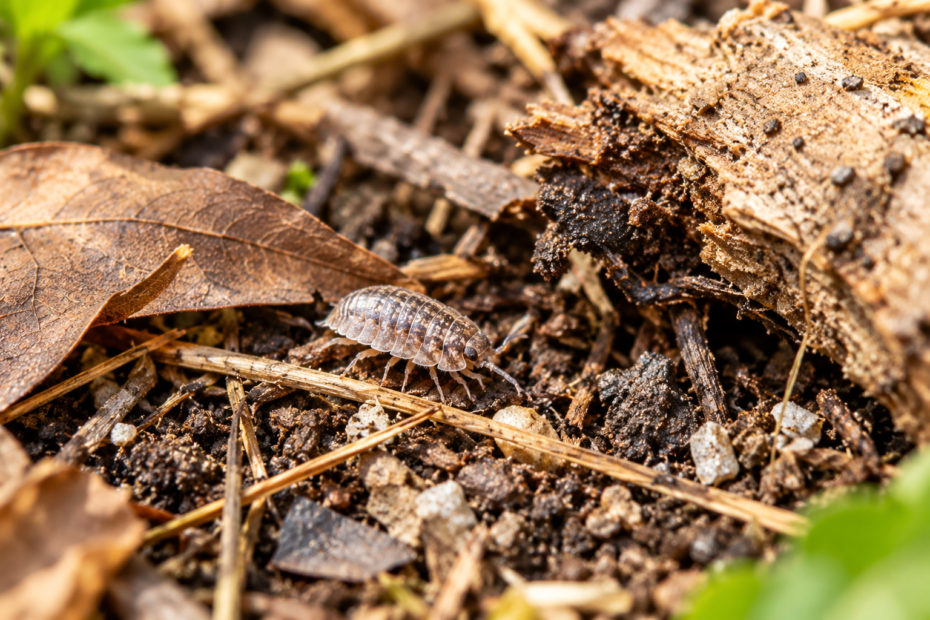
Pill bugs are useful classroom animals partly because a familiar observation—finding them beneath damp leaves, bark, or stones—leads naturally to a testable question: do they actually prefer moisture?
The biology suggests that water matters, but a good experiment still has to separate moisture from everything that changes along with it. A puddle is not simply “more humid” than damp paper, and a bone-dry chamber is not a neutral alternative. If one side is physically unpleasant or dangerous, the activity may demonstrate escape from stress rather than a subtle habitat choice.
Why terrestrial isopods respond to moisture
Pill bugs and sowbugs are terrestrial crustaceans. Their respiratory structures and body surfaces function best under humid conditions, and they lose water to dry air. Classic comparative work with Armadillidium vulgare, Porcellio scaber, and Oniscus asellus found that the species differ in their resistance to water loss and in the strength of their humidity responses. A. vulgare was the most resistant to desiccation of the three, while P. scaber showed a stronger humidity response.
This is one reason not to treat “isopods” as though every species should produce the same graph. It is also why a result from one classroom, population, or set of conditions should be described precisely rather than turned into a universal rule.
Movement into a humid area is not necessarily a direct march toward water. Research on terrestrial isopods has described hygrokinesis: animals move more in dry conditions and slow down in humid ones. More frequent turns can also help retain them in the more humid part of an arena. When students count more animals on the damp side, they are observing the combined outcome of movement, turning, stopping, and time—not a verbal decision by the animals.
The central design problem: damp is not drenched
For a simple choice chamber, use equal pieces of the same absorbent material on both sides. Leave one at the prepared baseline condition and moisten the other with a measured amount of water. The moist side should be evenly damp, without pooled water. Carolina Biological’s classroom protocol specifically warns that drenching the paper can make the result harder to interpret and may even lead pill bugs to remain on the nominally “dry” side.
A safer and more informative question is:
“Under our test conditions, how are Armadillidium vulgare pill bugs distributed between a moderately moist surface and a less-moist surface?”
That wording is less dramatic than “wet versus dry,” but it encourages students to describe the conditions they actually created.
A fair classroom protocol
- Prepare two equal sides. Use the same chamber area, paper type, paper size, cover, and lighting on both sides.
- Measure the water. Apply the same number of drops—or, better, the same measured volume—to every moist side. Record the amount rather than relying on “about damp.”
- Run a same-versus-same control. Test damp versus damp, or baseline versus baseline, before the main comparison. A consistent left-side preference suggests a chamber, light, airflow, or placement bias.
- Place animals in a neutral center. Give them a short, standardized settling period before beginning the timed counts.
- Count repeatedly. Record the number on side A, side B, and in the center at regular intervals. Every row should add up to the starting number.
- Reverse the sides. In a later trial, put the moist treatment on the opposite side. Keep every other step the same.
- Return the animals promptly. After the observation, move them back to a prepared habitat with appropriate moisture, shelter, food, and ventilation.
A ten-animal group is common in classroom protocols because the totals are easy to check, but the number should match the chamber size and lesson plan. Our guide to choosing pill bug counts for classroom labs works backward from the number of stations and animals per station.
Variables students should not ignore
Light: A brighter side may change behavior independently of moisture. Keep the chamber shaded evenly unless light is the intended variable. The light-versus-dark experiment guide explains why heat and moisture can otherwise become hidden explanations.
Shelter and wall contact: Isopods often spend time along edges or beneath cover. Both sides should offer comparable physical structure. Count center and boundary animals using a rule written before the trial begins.
Group behavior: One animal can influence where others gather. Our article on why pill bugs cluster explains why repeated group counts are not the same as ten independent choices.
Temperature: Water can cool one surface through evaporation, while a lamp or sunny window can warm one side. Keep the chamber away from direct sun and obvious heat sources.
Species: Use one species per comparison. Armadillidium vulgare and Porcellio scaber differ in body form, defensive behavior, and water-balance responses. See the pill bug and sowbug comparison before selecting animals.
How to interpret the data
A useful graph plots observation time on the horizontal axis and the number of animals in each section on the vertical axis. Students can ask whether the distribution became more consistent over time, whether reversing the chamber reversed the result, and whether the same-versus-same control showed a side bias.
The defensible conclusion should stay close to the evidence. For example:
“Across four trials, more pill bugs were recorded on the moderately moist side during 15 of 20 timed counts. The same-side control did not show a consistent left-right bias.”
That is stronger than saying pill bugs “always prefer wet places.” It identifies the species, treatment, observation unit, and limit of the claim. A different moisture contrast, temperature, chamber, or species might produce a different distribution.
Animal care sets the experimental boundary
Do not make a chamber dangerously hot, flooded, chemically treated, or desiccating simply to produce a clear response. Stop the trial if animals become trapped, remain overturned, show unusually frantic escape behavior, or if the chamber conditions depart from the safe range established for routine care. The goal is to observe behavior, not force a dramatic result.
Before the animals arrive, the pill bug lab supplies checklist covers chambers, timers, droppers, brushes, controls, and post-lab housing. Teachers who want to exchange variations or build on this investigation can also use the Ficarro Farms Living Laboratory as the growing home for classroom lab ideas.
When the protocol and group count are settled, browse the current live isopod listings. Choose animals for the lesson you have planned, and contact Ficarro Farms for larger or date-sensitive classroom needs rather than assuming future availability.