
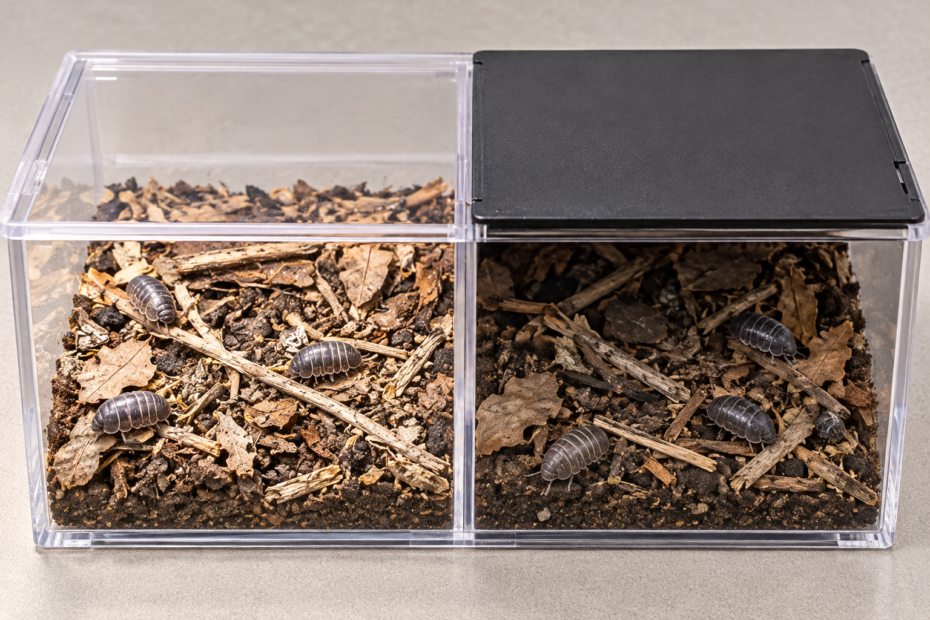
A light-versus-dark pill bug experiment looks simple: build a choice chamber, darken one side, add isopods, and count where they go. The biology is interesting, but the experiment becomes much more useful when the chamber actually isolates light from the other things that isopods respond to.
That distinction matters. A covered compartment may be darker, but it may also be cooler, more humid, or more physically sheltered. If all of those conditions change together, the animals may make a clear choice while the class remains unable to say what they chose.
What the experiment is really testing
Terrestrial isopods can distinguish illuminated from darker areas, and controlled studies often find movement toward lower illumination. That response is commonly described as negative phototaxis. It is sensible biology for an animal that loses water across respiratory and body surfaces and is often active in protected, humid places.
Still, “pill bugs prefer darkness” should be treated as a testable hypothesis, not a guaranteed classroom result. Species, hydration, temperature, light intensity, prior experience, and the design of the chamber can all affect what the animals do. Armadillidium vulgare and Porcellio scaber are both useful for behavioral work, but a result from one group in one chamber is not a universal rule for every isopod.
Build a fair light-versus-dark choice chamber
Use two connected compartments with the same usable area. Line both sides with the same material and add the same measured amount of water to each side. The goal is for light level to be the only intentional difference.
Darken one compartment from the outside with an opaque sleeve, folded card, or other cover that does not reduce the animals’ floor space. Avoid placing a hot lamp close to the illuminated side. A lamp can create a temperature and evaporation gradient, turning a light experiment into a combined light, heat, and moisture experiment.
If the dark side has a low ceiling or an object the isopods can press against while the light side is open, shelter and touch have also changed. Woodlice respond to contact with surfaces, and they aggregate socially. Keep the physical geometry as similar as possible on both sides.
A practical setup
- Two equal compartments connected by an opening
- Matching substrate or filter paper on both sides
- Equal moisture added with a pipette or measured dropper
- An external opaque cover over one side
- A central release area, if the chamber provides one
- A timer and a prepared data table
- Enough isopods to observe movement without crowding the chamber
Our pill bug lab supplies checklist covers the supporting materials, while the guide to classroom isopod container size explains why usable floor area matters.
Run a control before the real test
Before making one side dark, run the chamber with both sides arranged the same way. This same-versus-same control is one of the most valuable parts of the investigation. If the animals consistently collect on one side when the conditions are supposedly identical, the chamber may have a side bias caused by light from a window, a slope, an uneven moisture patch, a seam, or simply the room layout.
Then run the light-versus-dark trials, switching which physical side is dark between replicates. Randomizing or alternating the dark side prevents “left” or “right” from becoming confused with the treatment.
A clear procedure students can repeat
- Prepare both sides with equal substrate and moisture.
- Run a same-versus-same control and record the result.
- Cover the assigned dark side without changing its interior space.
- Place the isopods in the central release area and allow the same short acclimation period in every trial.
- Record the number on the light side, dark side, and in the center at fixed intervals.
- Continue for a predetermined observation period.
- Repeat the trial with the dark side reversed.
- Return the animals to an appropriate maintained habitat after the activity.
Counting every 30 seconds for 10 minutes is a common classroom protocol, but it is not the only defensible choice. What matters most is deciding the interval and total time in advance and using them consistently. A shorter observation period may fit a class better; a longer one may show whether the initial response persists.
Do not count one chamber as many independent experiments
Ten isopods sharing one chamber are not ten fully independent replicates. They can follow, contact, and aggregate with one another. Likewise, twenty time points from one trial are repeated observations of the same group, not twenty separate experiments.
For most classes, the clearest unit of replication is the chamber trial. Compare results across several chambers or repeated trials, while recording whether the same animals were reused. If isopods are used again, trial order may matter: recent work shows that experience with light and dark regions can affect later behavior.
How to record and interpret the results
A useful data table has one row for each time point and three count columns: light, dark, and center. A line graph of occupancy over time can show whether the response was immediate, gradual, or unstable. The class can also compare the average proportion of animals on each side during the final part of each trial.
A dark-side majority supports the hypothesis under the conditions tested. A mixed or null result is not a failed experiment. It may show that the light contrast was too small, that another variable competed with light, that the animals differed in condition, or simply that this sample did not produce a strong response. Those are scientific questions worth discussing, not reasons to rewrite the observation.
How many isopods should you order?
Choose the chamber design and number of simultaneous student groups first, then calculate the animals needed. Our guide to how many pill bugs a classroom lab needs works through that calculation without assuming that more animals automatically make a better experiment. Current classroom quantities are listed with our live isopods.
After the lab, keep the animals in a ventilated, moisture-appropriate habitat with leaf litter and protected areas. The general isopod care guide is a practical starting point.
Source notes and limitations
A 2024 laboratory study confirmed that terrestrial isopods can discriminate light and dark nesting regions and also found that experience can influence later choices. Research on Porcellio scaber shows that brightness, shelter, individual preference, and social attraction can all shape aggregation. A separate study of P. scaber and A. vulgare found that light exposure and hydration state affected locomotor behavior. Carolina Biological’s classroom choice-chamber protocol provides a useful model for fixed-interval observations and one-variable-at-a-time design.
These sources support the experimental principles, but they do not guarantee a particular outcome in a classroom. Light intensity, temperature, chamber materials, animal history, and local conditions should be recorded whenever possible. The strongest conclusion is always limited to the animals and conditions actually tested.
References
- University of Akron, Phototaxis in the Terrestrial Isopod: A Mechanism for Investigating Invertebrate Learning and Memory (2024).
- Devigne C., Broly P., Deneubourg J.-L., “Individual Preferences and Social Interactions Determine the Aggregation of Woodlice,” PLOS ONE (2011).
- “Reactivity to pseudorandom environmental patterns in woodlice: Effects of hydric deprivation and light exposure” (2023).
- Carolina Biological Supply, “Pill Bug Behavior Choices.”