
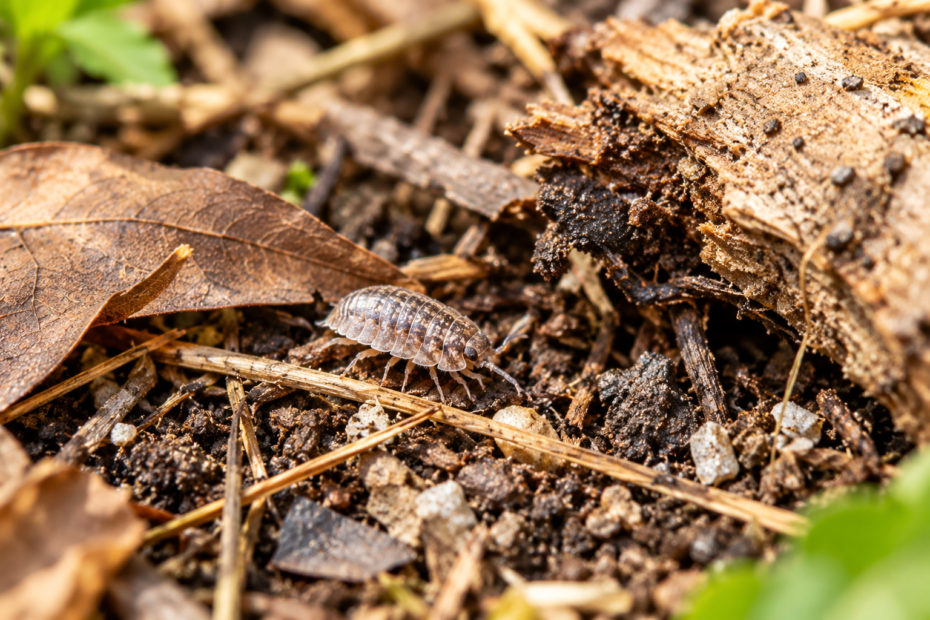
Springtails are often described as a required “cleanup crew” for an isopod enclosure. That phrase is useful shorthand, but it can also hide the biology. Springtails can help process fungi and fine organic residues in a moist habitat. They do not make an enclosure self-cleaning, and Armadillidium vulgare or Porcellio scaber do not need springtails in order to survive.
The practical answer is simple: springtails are optional partners. They can be helpful when the enclosure suits them, but good ventilation, a sensible moisture gradient, appropriate food, and regular observation matter much more than adding another animal.
What springtails actually do
Springtails are tiny soil- and litter-dwelling arthropods in the group Collembola. Many species feed on fungi, algae, bacteria, pollen, and decaying organic material. In a moist isopod enclosure, they usually occupy the same humid microhabitats where fungal growth and fine residues accumulate.
That feeding can be useful. A springtail population may graze some surface fungi and help fragment small bits of organic matter. The important word is some. Springtails are not interchangeable, and neither are fungi. Laboratory studies have found that springtails forage selectively among fungal taxa, while other work shows that their effects on fungal biomass and microbial activity change with springtail density. A white patch of fungal growth is therefore not proof that the springtails have failed, just as a springtail culture is not a guarantee that mold will disappear.
Are springtails necessary for isopods?
No. Terrestrial isopods can be maintained successfully without springtails when their basic habitat needs are met. Start with the conditions the isopods themselves require:
- a covered, ventilated container;
- substrate that retains moisture without remaining waterlogged;
- a moist refuge plus a somewhat drier area;
- leaf litter and shelter;
- small, appropriate food portions; and
- removal of spoiled food or heavily contaminated material.
Our first isopod colony checklist puts those basics in order. The shorter isopod care sheet is useful for routine checks after the colony is established.
If those fundamentals are wrong, springtails will not repair them. Too much food still decomposes. Poor airflow still traps humidity. Saturated substrate still loses useful air spaces. A springtail population may increase in a very wet enclosure, but its abundance should not be mistaken for evidence that the enclosure is well balanced for isopods.
What springtails can—and cannot—help with
They may help with:
- grazing certain fungi on leaf litter, wood, and the substrate surface;
- processing very small food particles and decaying residues;
- adding another observable member to a litter-community model; and
- making nutrient cycling easier to discuss in a classroom habitat.
They do not replace:
- removing rotten or mold-covered supplemental food;
- correcting excessive moisture or inadequate ventilation;
- replacing exhausted or contaminated substrate;
- monitoring temperature; or
- quarantining a questionable culture before it enters an established colony.
There is also no reason to chase a perfectly mold-free enclosure. Fungi are normal participants in decomposition. The management question is whether growth is limited and the habitat remains suitable—not whether every fungal hypha has vanished.
When adding springtails makes sense
Springtails are most useful in a consistently moist, established enclosure with decaying plant material and enough microscopic food to support them. They are a reasonable addition when you want a more diverse litter community, when small patches of fungal growth recur despite sound husbandry, or when students are studying interactions among decomposers and microorganisms.
They are less useful as a reaction to an acute husbandry problem. If food is visibly rotting, remove it. If the substrate is saturated, improve drainage and airflow while preserving a moist refuge. If the habitat smells sour or anaerobic, correct the underlying conditions rather than adding animals.
When adding a culture, use one from a source you trust. Introduce a modest amount near the moist side of the enclosure and give the population time to establish. Do not flood the habitat to favor springtails; the enclosure still has to serve the isopods. Watch what happens over several weeks before deciding whether the addition made a useful difference.
A careful classroom comparison
The springtail question can become a good lesson in experimental design, provided the claim stays narrow. Students might compare two or more otherwise similar small habitats, with springtails added to half and no springtails added to the others. Keep substrate, moisture, food, container, light, and temperature as consistent as possible.
Photograph the same marked area on a fixed schedule and estimate the percentage covered by visible fungal growth. Record moisture observations, food remaining, and springtail presence at the same time. Replicate each treatment if materials permit. One container per treatment cannot separate a springtail effect from ordinary differences between containers.
The result should be phrased carefully. “Visible fungal coverage was lower in these springtail containers during this interval” is evidence. “Springtails prevent mold” is a much broader claim than the experiment can support. Our Living Laboratory provides a useful framework for defining variables and keeping observation distinct from interpretation.
The useful conclusion
Springtails can be valuable members of an isopod habitat, but they are helpers rather than requirements. Add them because their feeding role and behavior fit your goal—not because the enclosure is expected to manage itself. Prepare the habitat first, observe it closely, and let the biology guide the decision.
If you are building a colony for observation or teaching, you can compare currently listed live isopods after the enclosure is ready. Product availability and counts vary, so check the individual listing before planning a time-sensitive activity.
References
- University of Maryland Extension: Springtails (updated August 4, 2023).
- Selective foraging of fungi by collembolans, Ecology.
- Effects of springtail density on fungal standing crop and microbial respiration, indexed by PubMed.