
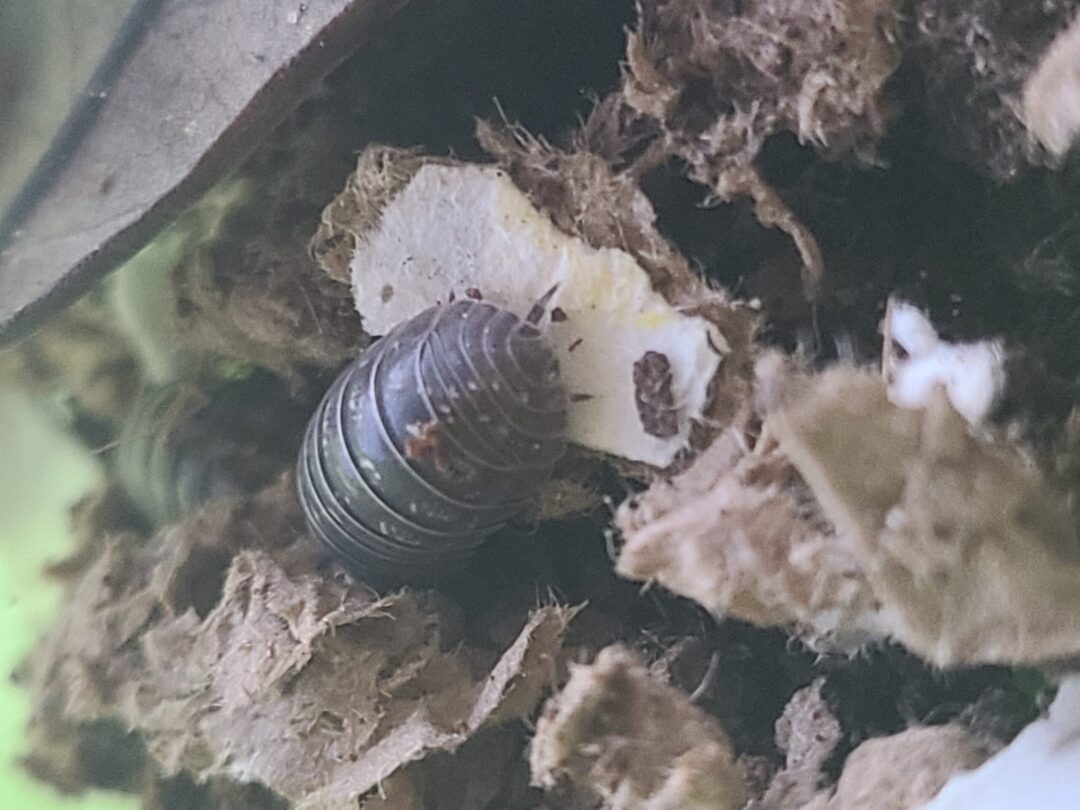
Isopods are often described as animals that need moisture, but that statement is incomplete. They also need oxygen. Good husbandry depends on supplying both without turning the enclosure into a stagnant, saturated container.
The reason is biological: pill bugs and sowbugs are terrestrial crustaceans. Their respiratory structures are associated with the pleopods—the paired appendages beneath the abdomen—not with insect-style tracheal tubes or vertebrate lungs. Understanding that anatomy explains why a damp refuge is useful, why standing water is dangerous, and why ventilation cannot be treated as optional.
Where an isopod breathes
Look at the underside of an adult isopod and you will find overlapping plates beneath the abdominal region. These are the pleopods. In terrestrial isopods, portions of the pleopods function in gas exchange. Different lineages have modified them in different ways, ranging from relatively exposed respiratory fields to enclosed structures commonly called pleopodal lungs or pseudotracheae.
Those terms can be misleading if taken too literally. An isopod lung is not a miniature mammalian lung, and a pleopodal gill is not simply an exposed fish gill. These are specialized crustacean appendages that exchange gases across thin surfaces while also participating in water and ion balance.
In Porcellio scaber, the common rough sowbug, well-developed air-breathing structures occur on the first two pairs of pleopods. Developmental work shows that the second-pair lungs form very early after hatching and become functional before the first-pair lungs finish developing. Other portions of the pleopods retain gill-like and osmoregulatory roles. The result is a respiratory system that reflects the animal’s aquatic ancestry and its successful life on land.
Armadillidium vulgare, the familiar pill bug that can roll into a ball, also has specialized pleopodal lungs. Comparative studies show that respiratory structure, cuticle thickness, body size, and behavior all contribute to desiccation resistance. That is one reason it is unwise to assume that every isopod species requires exactly the same moisture schedule.
Why moisture still matters
Gas exchange requires a thin, permeable interface. If that surface becomes too dry, respiration and water balance are impaired. Terrestrial isopods reduce this problem through lung structure, protective cuticle, shelter-seeking behavior, aggregation, and activity patterns, but none of those adaptations makes them independent of environmental moisture.
Research comparing terrestrial isopods consistently finds strong species differences in water loss and desiccation tolerance. A. vulgare is notably resistant among commonly studied species, while P. scaber also has covered lungs associated with life in comparatively dry terrestrial microhabitats. Even so, both animals normally seek protected spaces beneath leaf litter, bark, wood, or stones where humidity is higher and air movement is moderated.
This is why a completely dry enclosure is not appropriate. The animals need access to a reliably damp microhabitat, especially after shipping, during molting, and when they are young.
Why “more water” is not the whole answer
A moist respiratory surface does not require a waterlogged enclosure. When every part of the substrate is saturated, pore spaces fill with water and the movement of oxygen through the substrate slows. Decomposition can then consume oxygen faster than it is replaced. Food scraps and dense organic material may become anaerobic, producing sour or foul odors and creating conditions that are poor for the colony.
Standing water also creates a direct physical hazard. Terrestrial isopods can tolerate brief contact with water, and some species exchange gases in water better than others, but a culture container is not an aquatic habitat. Smooth-sided dishes, deep puddles, and saturated depressions can trap small animals or mancae.
The practical goal is therefore not “maximum humidity.” It is a moisture gradient with usable airflow.
A practical enclosure pattern
A well-managed isopod enclosure gives the animals choices. The following pattern works better than trying to hold every square inch at one condition:
- Maintain a damp refuge. Keep one area of the substrate consistently damp beneath leaf litter, bark, or another shelter. Damp should mean moist throughout, not dripping or submerged.
- Leave another area less wet. This does not need to be bone-dry. It simply gives the colony an alternative when the damp end becomes too wet or the room becomes humid.
- Use ventilated openings. Ventilation permits oxygen exchange and lets excess moisture leave the container. The amount needed depends on lid design, room conditions, substrate depth, and species.
- Provide structure at the surface. Leaf litter and cork or aged wood create shaded pockets that retain humidity without sealing the animals into saturated substrate.
- Avoid deep standing water. Add moisture gradually and distribute it through substrate rather than leaving open puddles.
- Watch the colony, not just the calendar. Condensation, odor, substrate texture, food breakdown, and where the animals gather are more informative than a fixed spraying schedule.
Our guide to misting an isopod enclosure explains how to adjust water additions to the container rather than following a universal number of sprays. A hygrometer can be useful, but it measures the air at one point and does not tell you whether the lower substrate is saturated or whether a sheltered pocket has dried out.
What colony behavior can tell you
Behavior is evidence, but it must be interpreted cautiously. A colony packed tightly into the dampest corner may indicate that the rest of the enclosure has become too dry. Animals spending unusual amounts of time near ventilation openings may be responding to excess moisture, low oxygen, heat, irritating waste products, or several conditions at once.
Neither observation identifies a single cause by itself. Check the entire system: moisture at different depths, temperature, ventilation, recent feeding, odor, and whether the behavior changed after a specific adjustment. Changing one variable at a time makes the result easier to interpret.
Species also matter. A. vulgare and P. scaber differ in body form, defensive behavior, and aspects of respiratory anatomy. Our pill bug versus sowbug comparison is a useful starting point when the two are being maintained or studied side by side.
A useful classroom connection
Respiration gives biological meaning to moisture-choice experiments. Students are not merely watching animals “like water.” They are observing behavior shaped by the competing demands of preventing water loss, obtaining oxygen, avoiding saturation, regulating temperature, and finding shelter.
That distinction improves both the experiment and the conclusion. A damp-versus-dry choice chamber cannot prove that moisture is the only factor controlling movement. The sides must also be matched for light, temperature, shelter, surface texture, and airflow. Side positions should be reversed between trials, and the animals should be returned to suitable culture conditions before either treatment becomes stressful.
Our moisture-preference experiment guide provides a controlled classroom method. Afterward, students can use pleopodal respiration to explain why their results are biologically reasonable while still acknowledging alternative explanations and species differences.
What this means for routine care
The best enclosure is not the wettest enclosure and not the most heavily ventilated one. It is a system that preserves a damp refuge, prevents stagnant saturation, and allows the animals to select among nearby microclimates.
For most keepers, that means checking conditions with fingers and eyes, adding water deliberately, keeping the food load conservative, and adjusting ventilation only after observing how the enclosure actually behaves. Exact humidity numbers can create false confidence because the reading at lid height may differ sharply from conditions beneath bark or several centimeters into the substrate.
Teachers, hobbyists, and keepers who need animals for observation can view our current live isopod listings. Availability changes, so the category page is more reliable than a promise about one count or species.
Sources and further reading
- Inui, N., Kimbara, R., Yamaguchi, H., & Miura, T. (2022). Pleopodal lung development in a terrestrial isopod, Porcellio scaber. Arthropod Structure & Development, 71, 101210.
- Wright, J. C., & Ting, K. (2006). Respiratory physiology of the Oniscidea: aerobic capacity and the significance of pleopodal lungs. Comparative Biochemistry and Physiology Part A, 145(2), 235–244.
- Csonka, D., et al. (2013). Eco-morphological studies on pleopodal lungs and cuticle in Armadillidium species. Arthropod Structure & Development, 42(3), 229–235.
- Antoł, A., et al. (2021). Effects of body size and lung type on desiccation resistance, hypoxia tolerance and thermal preference in two terrestrial isopod species. Journal of Thermal Biology, 99, 102999.
Isopod respiration is a good example of evolution working with inherited structures rather than starting over. Their pleopods still reveal a crustacean past, but specialized lungs, protective cuticle, and behavior allow them to live on land. Good care respects both sides of that history: moisture for respiratory function and airflow for a healthy terrestrial habitat.