
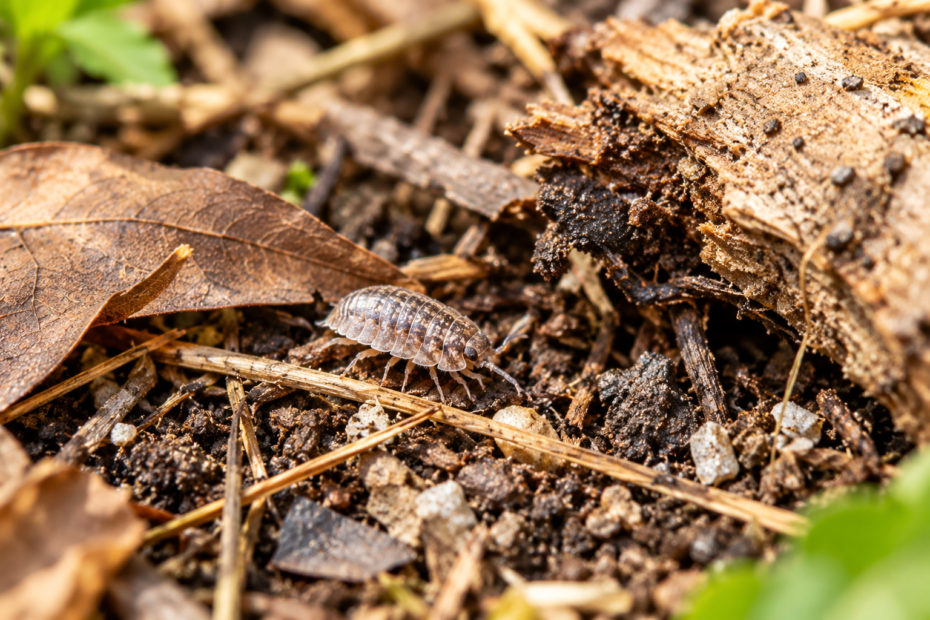
How often should you mist an isopod enclosure? The most accurate answer is not “every day” or “three times a week.” It is: check the habitat regularly, keep a dependable damp refuge available, and add water when that refuge begins to dry.
That answer may sound less convenient than a calendar, but it is more useful. An enclosure with deep substrate, a fitted lid and modest ventilation loses water very differently from a shallow, highly ventilated container in an air-conditioned classroom. Room temperature, seasonal humidity, substrate composition, colony size and species all affect how quickly conditions change.
Why moisture matters so much to isopods
Terrestrial isopods are crustaceans that have adapted to life on land, but water balance still shapes where they live and how they behave. They lose water through the body surface and respiratory structures on the underside of the abdomen. Research on Armadillidium vulgare found measurable water loss even at relatively high humidity, while rolling into a ball reduced water loss under drier conditions.
Classic experiments with Porcellio scaber and A. vulgare also showed that isopods tend to remain longer in moist areas by slowing down and changing their turning behavior. This is one reason a dry colony may appear unusually restless or concentrated in the last damp corner. Behavior is a clue, however—not a moisture meter and not a diagnosis by itself.
The practical goal: a moisture gradient
A useful enclosure does not need to be uniformly wet. It should offer at least one reliably damp zone beneath cover, along with an area that is less wet. The animals can then move among microclimates instead of being trapped in one condition.
For the species we commonly discuss at Ficarro Farms, that gradient matters for slightly different reasons. A. vulgare is relatively resistant to drying and can reduce water loss by conglobating. P. scaber does not form the same tight ball and shows a strong behavioral response to humidity. Those differences are biologically interesting, but they do not translate into one proven misting interval for either species.
A better routine than “mist every day”
- Check daily while an enclosure is new. You are learning how quickly that particular setup changes. Once the pattern is clear, the checks can remain quick even if water is added less often.
- Look beneath the surface. Lift one shelter or gently inspect the damp side under the leaf litter. A dry-looking top layer can hide moisture below, while a glossy surface can hide a substrate that is drying underneath.
- Add water to the damp zone, not everywhere. Use a fine mist for small adjustments. If deeper substrate is drying, a small measured addition to one side may restore the reservoir more effectively than repeatedly wetting only the surface.
- Wait before adding more. Water needs time to spread through soil, coco fiber, decayed leaves and other materials. Recheck before turning a correction into a flood.
- Record what happened. Note the date, the amount added and any change in room conditions. Within a week or two, the enclosure will tell you far more than a generic schedule can.
What to look for
| Observation | What it may mean | Reasonable response |
|---|---|---|
| The damp refuge is cool and slightly moist below the surface | The moisture reservoir is still present | Do not add water simply because the calendar says to |
| The damp side is drying through its depth | Water is being lost faster than it is replaced | Add a modest amount to that zone and recheck after it spreads |
| Condensation covers most walls for long periods | The enclosure may be too wet, too warm or insufficiently ventilated | Pause watering and inspect substrate moisture, temperature and airflow |
| Standing water or saturated, airless substrate | The habitat is waterlogged | Remove excess water if possible and correct the source; do not add more |
| Animals crowd one location | They may be responding to moisture, shelter, temperature, food or social cues | Inspect all conditions rather than assuming crowding proves dryness |
Why the number of sprays is not a useful standard
“Five sprays” sounds precise, but spray bottles differ in output, droplet size and coverage. Five sprays into a small ventilated cup are not equivalent to five sprays into a large habitat with several inches of absorbent substrate. If consistency matters, especially in a classroom, measure the water volume occasionally rather than counting trigger pulls.
A hygrometer can help reveal trends, but it does not replace inspection of the substrate. The sensor measures conditions where it sits; it cannot tell you exactly what is happening beneath leaf litter, inside a damp hide or several centimeters down. Treat the reading as one piece of evidence.
A simple classroom care record
For a classroom colony, assign one student or group to record three observations: moisture below the damp-side shelter, visible condensation, and the location of most animals. Add the volume of water only when needed and record it. This creates a useful husbandry record while teaching students the difference between an observation and an interpretation.
If the class is investigating moisture preference, routine watering should happen outside the observation period and be documented. Otherwise, the act of misting can become an uncontrolled treatment. The guide Do Pill Bugs Prefer Moisture? explains how to test the question without drenching the chamber.
The bottom line
Check a new habitat daily, but water according to conditions rather than habit. Maintain a damp refuge, preserve a gradient, and avoid both complete drying and saturation. As the enclosure stabilizes, your notes will reveal its actual watering rhythm.
If you are preparing for a first colony, start with the setup and arrival checklist and the concise isopod care sheet. Educators can explore controlled investigations in the Living Laboratory. When the habitat is ready, compare the live isopod listings by species and count.
Research sources
- Smigel, J. T., & Gibbs, A. G. (2008). Conglobation in the pill bug, Armadillidium vulgare, as a water conservation mechanism. Journal of Insect Science, 8(44).
- Gunn, D. L. (1937). The humidity reactions of the wood-louse, Porcellio scaber. Journal of Experimental Biology, 14, 178–186.
- Gunn, D. L., & Kennedy, J. S. (1941). The mechanisms of humidity reactions of terrestrial isopods. Journal of Experimental Biology, 18, 115–135.
- Wright, J. C., & Machin, J. (1990). Water vapour absorption in terrestrial isopods. Journal of Experimental Biology, 154, 13–30.