
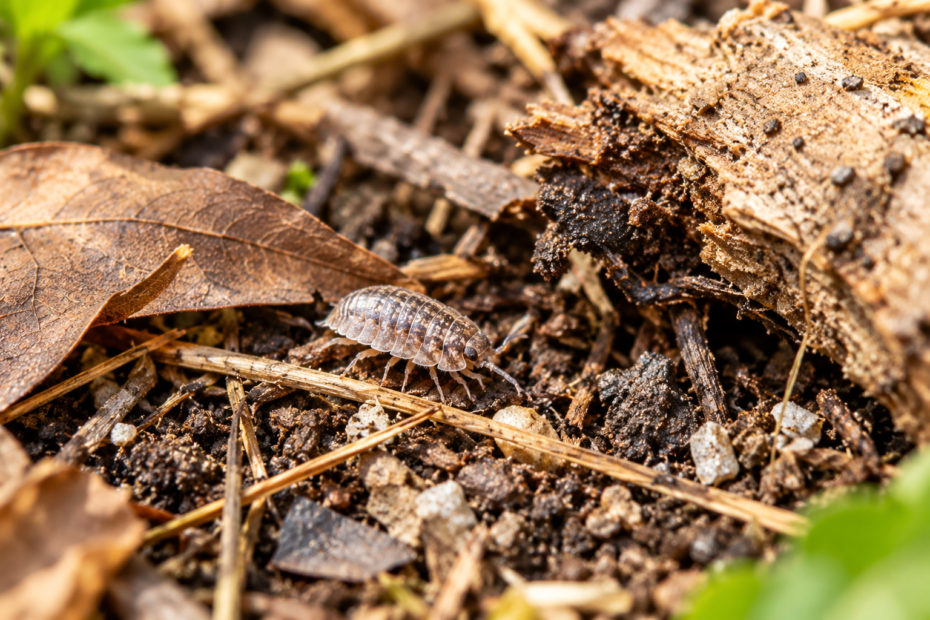
Terrestrial isopods need dependable access to water, but that does not mean they need a miniature pond. In most well-designed enclosures, an open water dish adds more risk than benefit. A moist refuge, damp food, and water held within the substrate can meet the animals’ needs while preserving the air-filled spaces that terrestrial crustaceans depend on.
This distinction matters because pill bugs and sowbugs are not insects. They are crustaceans that have adapted to life on land, and their water balance is closely tied to their respiratory anatomy. The practical goal is not to keep every surface wet. It is to provide reliable moisture without turning the enclosure into a saturated, oxygen-poor habitat.
The short answer
Most colonies of Armadillidium vulgare and Porcellio scaber do not require an open water dish. They should have continuous access to a damp zone, but the water can be held safely in moist substrate, decaying leaves, wood, sphagnum, or another appropriate refuge.
A water station can be used in a classroom culture or unusually dry enclosure, but it should not contain enough exposed water for an isopod—especially a tiny manca—to become submerged. A shallow cap filled with an absorbent material is fundamentally different from an open bowl.
How terrestrial isopods obtain water
Isopods use several routes rather than relying on one drinking behavior. Classic experiments with P. scaber, A. vulgare, and related species found that they can take in water from moist food, drink from a free water surface, and imbibe water from a damp surface through the mouth. Later physiological work showed that some terrestrial isopods can also absorb water vapor when surrounding humidity rises above a species-specific threshold.
That biology explains why a damp refuge works. An isopod does not need to stand beside a visible pool to obtain water. Moist surfaces and humid crevices provide access while allowing the animal to move away when conditions become too wet.
For a closer look at the respiratory side of this problem, see how isopods breathe and why moisture and ventilation must be balanced.
Why an open dish is an avoidable risk
Terrestrial isopods retain respiratory structures on the underside of the abdomen, but they are not simply small aquatic crustaceans. In a comparative immersion study, most A. vulgare, P. scaber, and Oniscus asellus died by 18 hours when kept underwater. Their oxygen uptake in water was substantially lower than in air.
That result does not mean a brief accidental step into a drop of water is automatically fatal. It does show why prolonged submersion is not a reasonable hydration strategy. A smooth-sided dish can also trap small animals, and juveniles are easier to overlook than adults.
Standing water creates other management problems as well. It can spill into the substrate, erase the moisture gradient, and contribute to anaerobic pockets. A dish also tempts the keeper to judge the habitat by whether the bowl is full rather than by whether the enclosure itself provides a useful damp refuge.
Build a moisture gradient instead
A safer enclosure gives the animals choices:
- Keep one refuge consistently damp. Moisten the substrate beneath bark, leaf litter, or another hide on one side of the enclosure.
- Leave another area less wet. It should not be bone-dry, but it should contain more air and allow the animals to move away from saturation.
- Retain ventilation. Moisture is necessary; stagnant, waterlogged conditions are not.
- Check the substrate, not just the air. A hygrometer measures relative humidity around its sensor, not the amount or distribution of water in the bedding.
- Adjust from observation. Drying speed depends on ventilation, substrate depth, room temperature, enclosure size, and colony activity.
There is no honest universal misting interval. The practical method is to inspect the damp refuge and replenish it before it dries completely. The related guides on how often to mist an isopod enclosure and what a hygrometer can and cannot tell you explain how to make that judgment.
If you choose to use a water station
Some classroom cultures and very dry rooms benefit from a small, visible moisture station. If you use one, reduce the exposed-water risk:
- Use a very shallow lid rather than a deep bowl.
- Fill it with damp paper, clean sponge material, smooth pebbles, or another structure that prevents full submersion.
- Keep it level and away from the enclosure wall, where animals may become wedged.
- Inspect it daily for trapped mancae, spoiled food, mold, or overflow.
- Treat it as a supplement to a damp refuge—not as a replacement for moist substrate.
Replace disposable absorbent material before it degrades. Do not add sugar, electrolyte mixes, plant fertilizer, or other supplements to the water unless a specific veterinary or research protocol calls for them.
Species and behavior still matter
Armadillidium vulgare can roll into a tight ball. Research shows that this conglobation posture reduces water loss under dry conditions. Porcellio scaber cannot seal itself into a sphere and uses a different combination of movement, sheltering, and physiology. Those differences are useful in both husbandry and classroom observation, but neither species should be forced into a single humidity number or a permanently wet enclosure.
The pill bug versus sowbug comparison explains these differences in more detail. For current cultures, Ficarro Farms offers 10-count Armadillidium vulgare and 10-count Porcellio scaber. Both product pages were published and marked in stock when this article was written, but availability can change.
A useful classroom observation
Students can examine water-seeking behavior without using an open dish. Place a piece of damp filter paper or paper towel at one end of a shallow observation chamber and an equally sized dry piece at the other. Keep light, temperature, texture, and shelter as similar as possible. Record where the animals are at fixed intervals, reverse the two sides midway through the activity, and return the isopods to their habitat promptly.
This does not measure “thirst” directly. It measures location under a particular set of conditions, and the result may reflect humidity, surface contact, prior hydration, aggregation, or side bias. That limitation is part of the science, not a flaw to hide. The full moisture-preference experiment gives a more controlled protocol.
Practical conclusion
Provide water as a property of the habitat rather than as a deep, exposed pool. A dependable damp refuge, a less-wet area, appropriate food, and adequate ventilation give terrestrial isopods the range of conditions they need to regulate themselves. If you add a water station, make it shallow, structured, and impossible to enter fully.
Sources
- Spencer, J. O., and Edney, E. B. “The Absorption of Water by Woodlice.” Journal of Experimental Biology 31 (1954): 491–496. https://doi.org/10.1242/jeb.31.4.491
- Wright, J. C., and Machin, J. “Atmospheric Water Absorption and the Water Budget of Terrestrial Isopods.” The Biological Bulletin 184 (1993): 243–253. https://doi.org/10.2307/1542232
- Taylor, B. E., and Carefoot, T. H. “Terrestrial Life in Isopods: Evolutionary Loss of Gas-Exchange and Survival Capability in Water.” Canadian Journal of Zoology 71 (1993): 1372–1378. https://doi.org/10.1139/z93-189
- Smigel, J. T., and Gibbs, A. G. “Conglobation in the Pill Bug, Armadillidium vulgare, as a Water Conservation Mechanism.” Journal of Insect Science 8 (2008). PubMed record
- Flinn Scientific. Isopod Care Guide.