
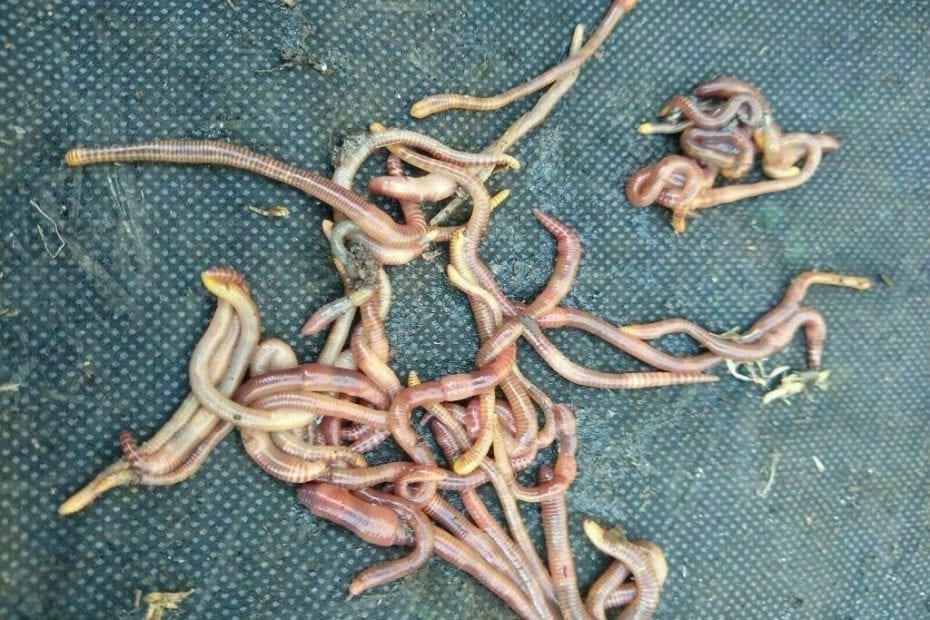
Red wigglers do not have eyes in the familiar sense. There is no lens, retina, or paired organ that forms an image of the world. Yet a worm uncovered in a bright room usually begins moving almost at once. That is not a contradiction. Eisenia fetida detects light with sensory structures distributed through the body wall, then uses its nervous system to organize an escape response.
This distinction matters in practice. A red wiggler does not need to “see” the way we do to recognize that it has been exposed. Light is a useful environmental signal: at the surface, the worm is more vulnerable to drying and predation, while darkness usually indicates the moist organic layer where this species feeds and lives.
What a red wiggler can detect
Earthworm photoreceptors are not gathered into eyes. They occur in the epidermis and connect with sensory pathways that carry information into the ventral nerve cord. The front end is especially responsive, but light sensitivity is not confined to one small “eye spot.” Classic experiments with Eisenia foetida showed that the central nervous system helps determine the direction and character of the response rather than merely triggering an isolated muscle contraction.
Modern anatomical work on Eisenia fetida has identified several kinds of primary sensory cells and photoreceptor-containing sensory structures in the body wall. Genomic and transcriptomic studies also find molecular machinery associated with sensory perception. Together, the evidence supports a more accurate description than “worms are blind”: red wigglers do not form visual images, but they do sense changes in illumination and respond behaviorally.
Why light usually sends them downward
Red wigglers are epigeic earthworms. In nature they occupy surface layers rich in decaying leaves, manure, and other organic matter rather than constructing deep mineral-soil burrows. That habitat can be close to the surface, but it is normally shaded, moist, and structurally complex.
Moving away from ordinary bright light is therefore a sensible response. Exposure often coincides with conditions that threaten the worm’s water balance. Red wigglers exchange gases across a moist body surface, so drying is not merely uncomfortable; it interferes with respiration. Light itself is not a complete diagnosis, however. A worm climbing the walls of a closed bin may be responding to excessive moisture, low oxygen, heat, irritating food, or a recent disturbance as well as illumination.
If worms remain at the surface after the lid is replaced, inspect the habitat rather than trying to force them down with a brighter lamp. The guides on worm-bin moisture, oxygen and waterlogging, and worms climbing the bin walls help separate those causes.
What this means for daily worm-bin care
- Use an opaque or well-shaded bin. Clear containers are useful for brief observations, but a permanent culture should have a dark refuge. A fitted lid can exclude light while ventilation openings preserve airflow.
- Do not use direct sunlight to control behavior. Sunlight can warm a small container rapidly and dry the bedding. Heat and desiccation are hazards, not management tools.
- Keep observation brief. When checking food, bedding, or cocoons, uncover only the area you need and replace the cover when finished.
- Provide moist bedding with air spaces. Darkness cannot compensate for saturated, compacted bedding. The shredded-paper bedding guide explains how to prepare a loose, absorbent base.
- Treat unusual surface activity as evidence, not misbehavior. Check temperature, moisture, odor, remaining food, and ventilation before deciding what to change.
A humane classroom observation
Light response can be observed without prolonged exposure or a complicated maze. Use a shallow tray lined with uniformly damp, unprinted paper. Shade one half with an opaque cover raised slightly above the surface so it does not touch the worm. Illuminate the other half with diffuse room light or a lamp positioned far enough away that it does not warm the tray.
Place one red wiggler near the center line and record the time it spends on each side for two minutes. Return it to moist bedding promptly. Repeat with several different worms rather than testing the same animal again and again. Between trials, switch the shaded side so a left-right preference is not mistaken for a light response.
The most important control is temperature. Measure both sides before and after the observation; if the illuminated side is warmer, the activity tests light plus heat, not light alone. The paper should also be equally moist on both sides. Students can report individual results, the group average, animals that did not choose, and the limits of the setup. A short response study is more informative than exposing worms until every individual produces the expected answer.
This activity also opens a useful biological discussion: sensing does not require an image-forming eye. Animals have evolved many ways to detect environmental information, and a distributed receptor system can be entirely adequate for life within litter and compost.
Can red light be used for observation?
Some earthworm experiments use dim red illumination because the tested species respond less strongly to it than to bright white light. That does not justify assuming every red bulb is invisible to every red wiggler. Wavelength, intensity, distance, adaptation, and species all matter. For routine care, the safer rule is simpler: keep the culture shaded and use only as much light as needed for a short inspection.
The practical conclusion
Red wigglers have no eyes that form pictures, but they are not insensitive to light. Photoreceptive sensory structures in the body wall, especially toward the front, allow the nervous system to detect exposure and organize movement toward safer conditions. A dark bin therefore supports normal behavior—but darkness must be paired with correct moisture, oxygen, temperature, and feeding.
If you are preparing a new culture, begin with the step-by-step worm-bin setup guide. Ficarro Farms also offers 85 live red wigglers for an appropriately prepared bin; availability can change, so the product page is the current source for stock status.
Sources and further reading
- Oregon State University Extension: Composting with Worms
- Prosser (1934): Effect of the Central Nervous System on Responses to Light in Eisenia foetida
- Kiszler et al. (2016): Sensory-System Organization in Eisenia fetida
- Lights, Chemicals, Action: Studying Red Worms’ Responses to Environmental Contaminants