
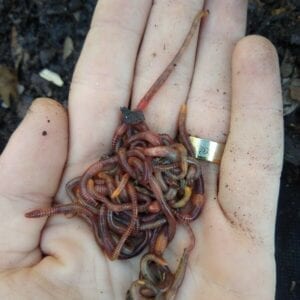
Seeing a few red wigglers on the damp sides of a worm bin is not automatically an emergency. The walls often collect moisture, especially after the lid has been closed, and an occasional worm may simply be exploring.
A different picture emerges when many worms gather near the lid, collect in the corners, or appear to be leaving the bedding at once. That kind of movement deserves a closer look. Red wigglers live in moist, decomposing organic material, but they still need oxygen and a stable environment. A bin can be wet enough for worms and still be too wet for good airflow.
The useful question is not merely, “How do I make them go back down?” It is, “What changed in the bin?”
First, look at the pattern
- One or two worms on a damp wall: often ordinary movement, especially at night or after the bin has been disturbed.
- Many worms around the lid or ventilation holes: check moisture, odor, temperature and airflow promptly.
- A sudden change after feeding: the amount or condition of the food may be affecting the bedding.
- A sudden change after moving or rebuilding the bin: the worms may be responding to a newly disturbed habitat, but the basic conditions still need to be checked.
Constantly rebuilding a healthy bin because of one wandering worm can create more disturbance than the original problem.
Check moisture and oxygen together
Red wigglers breathe through moist skin, so dry bedding is dangerous. Saturated bedding, however, can lose air space. North Carolina State University Extension notes that oxygen may become depleted when worm beds are too wet or too much feed is introduced. Oregon State University Extension likewise describes red wigglers as thriving in an aerobic environment.
Pick up a handful of bedding from below the surface. It should feel evenly moist without releasing a stream of water when gently squeezed. If water collects at the bottom, the material feels packed and heavy, or the bin smells sour rather than earthy, adding more water is not the answer.
Gently loosen compacted areas. Add clean, absorbent bedding in modest amounts and make sure ventilation has not been blocked. The goal is to restore structure and airflow without turning a small correction into a complete habitat reset.
Look at how much food is present
Overfeeding is less about one forbidden ingredient than about adding organic material faster than the bin can process it. Food begins decomposing through microbial activity before worms finish consuming it. A heavy food load can heat, sour or compact the bedding, and it can contribute to low-oxygen conditions.
If recognizable food is accumulating, pause feeding. Remove material that is clearly spoiled or producing a strong unpleasant odor, then wait until the bin settles before adding more. The correct feeding rate is the rate the particular bin can process under its current conditions—not a universal percentage of worm weight.
Our guide to how much food red wigglers can process explains why worm count, feedstock, temperature, moisture and bedding all affect the answer.
Check temperature
A worm bin can warm from the room around it, direct sunlight, or microbial activity inside a dense pocket of food. Feel the bedding in several places rather than judging only from the air above it. If the center is noticeably warm, remove the bin from any heat source, reduce the concentrated food load and allow heat to dissipate gradually.
Do not try to correct overheating with ice or a sudden flood of cold water. Abrupt changes create another stress while doing little to correct the underlying cause.
Consider recent changes
New bedding, a large feeding, a different container, blocked ventilation or a move to another room can all change conditions. Recently shipped worms also need time to settle into prepared bedding. When several changes happen at once, it becomes difficult to identify which one mattered.
Make one careful correction, record it and observe the result. That approach is slower than changing everything at once, but it is far more informative—and usually easier on the worms.
A calm troubleshooting sequence
- Check for immediate hazards. Move the bin away from direct sun or an obvious heat source.
- Smell the bin. A healthy system usually smells earthy. Strong sour or rotten odors suggest excess food, poor airflow or anaerobic pockets.
- Test the bedding by hand. Look for standing water, dry pockets and compaction.
- Inspect the food load. Pause feeding if material is accumulating.
- Restore air space gently. Loosen dense areas and add absorbent bedding if needed.
- Observe before making another major change. Record what you adjusted and what the worms do next.
If the worms are active in the bedding, the bin smells normal and only a few individuals are on the walls, observation may be more appropriate than intervention.
Paper bedding can help restore structure
Shredded paper can absorb excess moisture and increase the amount of loose bedding in a bin. It should be clean, prepared correctly and mixed in without packing it down. James has repeatedly used shredded paper successfully as a starter substrate for red wigglers at Ficarro Farms; that practical experience does not make every paper product interchangeable or remove the need to monitor moisture and airflow.
See Can Red Wigglers Live in Shredded Paper Bedding? for preparation guidance. Ficarro Farms also offers Premium Paper Bedding for customers who want a ready source of micro-cut paper. Check the current product page for availability and contents.
When this becomes a classroom investigation
Students can maintain a simple bin log that records moisture condition, room temperature, food added, visible worms on the walls and odor observations at the same time each day. The scientific value comes from documenting normal variation and changes in routine care—not from flooding, heating or drying the bin to force an escape response.
Starting with the right number of worms
A small observation project and an established composting bin do not require the same count. Review How Many Red Wigglers Do I Need? before ordering, and prepare the habitat first. Current red wiggler listings vary by count and availability.
For a date-sensitive classroom order, contact Ficarro Farms with the count, destination and preferred arrival date so availability can be checked before the lesson depends on it.
Sources and limits
- North Carolina State University Extension, Raising Earthworms Successfully: moisture, oxygen depletion, feeding and bed management.
- Oregon State University Extension, Composting with Worms: aerobic habitat, bedding, moisture and feeding principles.
Wall climbing is a sign to inspect the system, not a diagnosis by itself. The behavior may reflect moisture, oxygen, temperature, food, recent disturbance or ordinary exploration. No single observation can identify the cause without checking the rest of the bin.