
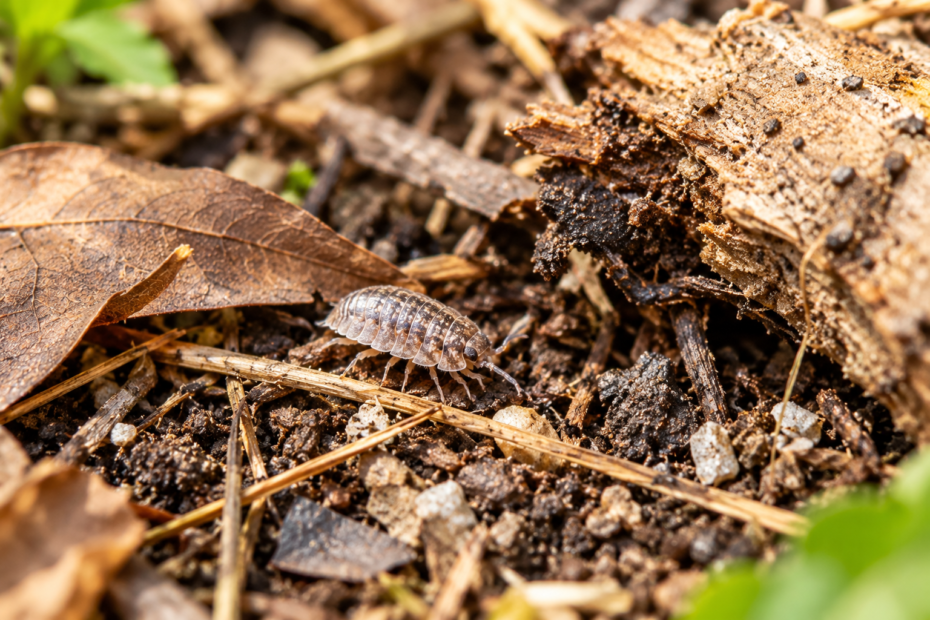
Turn over a fallen log or lift a handful of damp leaves, and you may find an entire community of small animals going about their lives. Among the most familiar are pill bugs, those gray, armored creatures that seem to appear wherever soil stays cool and moist.
Most people encounter them only briefly. A stone is moved, the animals scatter, and the stone goes back into place. But the world beneath that stone is worth a closer look.
Pill bugs belong to a group of terrestrial crustaceans called isopods. That makes them relatives of crabs and shrimp rather than insects, despite their familiar nickname, “bugs.” Their ancestors were aquatic, and even after adapting to life on land, they retained a close dependence on moisture.
Understanding that relationship helps explain nearly everything about where pill bugs live and how they behave.
A Life Shaped by Moisture
Unlike insects, which breathe through a system of air-filled tubes, terrestrial isopods exchange gases using specialized structures associated with their abdominal appendages. The details vary among species, but moisture remains important to their respiratory biology.
This is one reason pill bugs are so often found beneath logs, stones, and layers of fallen leaves. These places provide more than darkness. They create a relatively stable environment, sheltered from drying winds and rapid temperature changes.
The upper surface of a garden may become hot and dry in the afternoon, while the soil just beneath a thick layer of leaf litter remains noticeably cooler and damper.
For an isopod, that difference can determine whether a location is suitable for feeding, resting, or reproduction.
Not every species responds to moisture in precisely the same way. Some are better adapted to relatively dry conditions than others, and even individuals of the same species may change their behavior as conditions change. But the search for favorable moisture conditions is a recurring theme in terrestrial isopod life.
The Forest Floor Is a Living System
A fallen leaf does not simply disappear when it reaches the ground.
Over time, fungi and bacteria colonize it, its tissues begin to break down, and a variety of small animals feed on the changing material. Isopods are among those animals.
Many terrestrial isopods consume decaying leaves and other organic matter, often including material that has already been altered by microorganisms. As they feed, they fragment larger pieces into smaller particles and return processed organic material to the soil in their droppings.
This does not mean that pill bugs are solely responsible for decomposition. Fungi, bacteria, earthworms, millipedes, and numerous other organisms participate in the process. Their activities overlap, and the relative importance of each group changes with the environment.
What makes isopods interesting is their position within this community. They are both consumers of decomposing material and participants in the physical breakdown that helps shape the conditions under which further decomposition occurs.
A handful of leaf litter is therefore not merely a pile of dead plant material. It is habitat, food supply, shelter, and an active part of nutrient cycling.
Why They Gather Together
Anyone who has maintained a colony of pill bugs has probably noticed that the animals are not distributed evenly throughout their enclosure.
Even when plenty of space is available, several may crowd beneath the same piece of bark while other apparently suitable hiding places remain nearly empty.
Some of this clustering reflects shared preferences. If one location offers favorable moisture, temperature, and shelter, many individuals may independently choose it.
But aggregation can involve more than a coincidental preference for the same conditions. Research on terrestrial isopods has shown that social cues can influence grouping behavior in some species. Gathering together may also help create a more favorable local environment by reducing exposure to drying conditions.
It is tempting to describe these clusters as little families or communities, but that would imply more than the evidence necessarily supports. Their behavior is fascinating without requiring us to give it human motives.
What we can say is that an isopod’s surroundings include other isopods, and those neighbors may influence where it settles.
A Suit of Armor That Must Be Replaced
The hard outer covering of a pill bug provides protection, but it creates a problem as the animal grows: the exoskeleton cannot expand indefinitely.
Like other crustaceans, isopods grow by molting.
Terrestrial isopods have an especially interesting approach. Rather than shedding the entire exoskeleton at once, they typically molt in two stages. The rear portion is shed first, followed later by the front portion.
During this process, an animal may look unusually pale or appear to have two different colors. It is temporarily more vulnerable, and shelter becomes particularly important.
The discarded exoskeleton is often eaten, allowing the animal to recover some of the materials it contains.
Molting is one of the reasons a colony should not be judged solely by how active its members appear on the surface. Important events are taking place out of sight.
The Next Generation Begins in a Brood Pouch
Female terrestrial isopods carry developing offspring in a brood pouch called a marsupium, located beneath the body.
The young develop there before emerging as small, pale juveniles known as mancae. These resemble miniature adults but are not simply scaled-down copies: they emerge with one fewer pair of walking legs, gaining the final pair as they develop.
This reproductive strategy is another reminder of their crustacean ancestry. Rather than laying exposed eggs in the surrounding soil, the female provides a protected environment for early development.
Finding a few tiny mancae beneath a piece of bark can be easy to overlook. Yet their presence tells us something important: the habitat has supported not only adult survival but at least one successful reproductive event.
Over time, a thriving colony becomes a population containing animals of different sizes and ages, each responding to the same environment in somewhat different ways.
A Small Animal Worth Noticing
Pill bugs are ordinary animals in the best sense of the word. They are common enough that we can observe them without traveling to a remote wilderness or purchasing specialized equipment.
And yet they offer an unusually accessible window into some of biology’s central questions.
How do animals select a habitat? How do they balance the need to feed with the risk of drying out? Why do individuals gather? How does a population reproduce and grow? What happens to the leaves that fall every autumn?
These questions are not limited to pill bugs, but pill bugs make them visible on a remarkably manageable scale.
The next time you lift a log and see a cluster of isopods underneath, it is worth looking for a moment before putting everything back. The animals may be small, but the biological processes at work around them are anything but simple.