
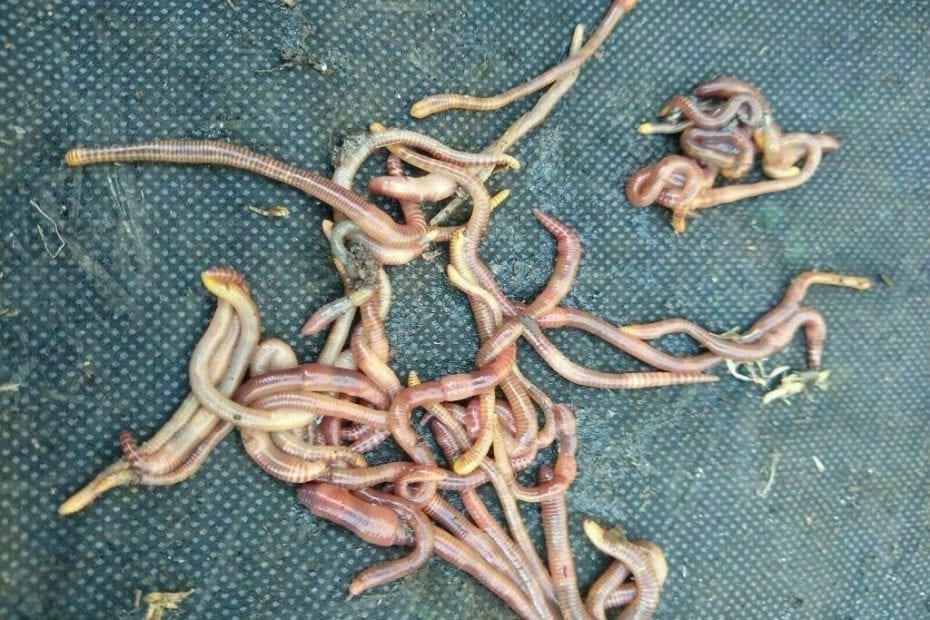
Red wigglers need moisture, but they also need oxygen. That combination explains an apparent contradiction in worm-bin care: bedding that is too dry interferes with normal gas exchange, while bedding that is saturated can become dangerous for an entirely different reason.
So, can red wigglers drown? In ordinary language, yes—but the more precise problem is oxygen deprivation. An earthworm can exchange gases across its moist skin, and some earthworms can remain submerged for a time when the surrounding water contains enough dissolved oxygen. A neglected worm bin is not a clean, continuously aerated aquarium. Microorganisms and worms consume oxygen, compacted organic matter slows its replacement, and standing liquid can create low-oxygen zones surprisingly quickly.
Why red wigglers need both water and air
Red wigglers (Eisenia fetida) do not have lungs. Oxygen diffuses across the body surface and into the blood, while carbon dioxide moves out. The skin must remain moist for that exchange to work. Research on E. fetida shows that low moisture reduces aerobic metabolism, probably because oxygen diffuses less effectively across a dry cuticle.
More water is not automatically better. In loose bedding, many small air spaces remain between paper fibers, decomposing leaves and food particles. When those spaces fill with water—or disappear because the bedding has collapsed into a dense paste—the route by which atmospheric oxygen reaches the worms becomes much poorer.
This is why the useful target is moist, porous bedding, not simply a high moisture percentage. If you want a practical way to judge that condition, see How Wet Should a Worm Bin Be? Moisture Without Mud.
Water does not kill every earthworm immediately
The familiar statement that earthworms come to the surface after rain because they will instantly drown is too simple. Controlled research has shown that earthworms can survive in oxygenated water, but tolerance differs greatly among species and ecological types. Mortality rises as dissolved oxygen falls, and different species reach their limits at different concentrations and times.
That distinction matters. Results from deep-burrowing or soil-dwelling earthworms should not be converted into an hour-by-hour survival promise for red wigglers. Eisenia fetida is an epigeic species adapted to oxygen-rich surface litter and decomposing organic material. In a bin, the sensible husbandry rule is to correct waterlogging promptly rather than test how long the worms can endure it.
What waterlogging changes inside the bin
- Air spaces disappear. Saturated, compacted bedding allows less movement of fresh air.
- Oxygen demand continues. Worms and aerobic microorganisms still respire.
- Anaerobic pockets develop. Low-oxygen decomposition can produce the sour or rotten odors associated with a failing bin.
- Worm behavior changes. Worms may crowd the surface, lid or ventilation holes as they seek a more favorable zone.
- Food remains unfinished. When conditions deteriorate, feeding slows and excess scraps add to the microbial oxygen demand.
Climbing is not proof of waterlogging by itself. Temperature, acidity, recent disturbance and poor bedding can produce similar behavior. Use several observations together. The troubleshooting guides on worms climbing bin walls and worm-bin odors can help separate those possibilities.
How to correct a waterlogged worm bin
- Stop adding water. Also pause feeding for a few days if uneaten scraps are accumulating.
- Remove obvious standing liquid. Work slowly so worms and cocoons are not poured away. Liquid draining from a stressed bin is leachate, not automatically a finished or aerated “worm tea.”
- Add dry, absorbent bedding. Fluffed shredded cardboard or plain paper absorbs excess water while restoring structure. Add it in portions rather than burying the colony beneath one dense mat.
- Loosen compacted areas gently. Lift and separate the bedding enough to reopen air spaces. There is no need to churn the entire bin aggressively.
- Check ventilation and drainage. Clear blocked air holes. If the bin is designed with drainage holes, make sure they are open and that the catch tray is not allowing liquid to stand against the base.
- Recheck the cause. Watery foods, a leaking lid, outdoor rain, overmisting and too little bedding can all return the bin to the same condition.
Our guide to preparing shredded-paper bedding explains how to keep the material damp while retaining the loose structure that supports airflow.
Preventing the problem
A well-managed bin should not require routine flooding or a fixed misting schedule. Water arrives from moist bedding and from the foods themselves. Melon, squash and other high-water scraps can change the moisture balance even when no one adds water directly.
Start with adequately damp bedding, keep a reserve of dry shredded material nearby, and watch the bin rather than the calendar. A closed-bottom indoor bin can work when additions are conservative and the bedding remains porous. A draining design adds a margin of safety, but drainage holes do not compensate for chronic overfeeding, compaction or a blocked catch area.
If you are establishing a new system, How to Start a Red Wiggler Worm Bin at Home covers the full setup. Ficarro Farms also offers live Eisenia fetida for small composting and teaching colonies.
A safer classroom investigation
Students do not need to submerge live worms to study the problem. Prepare equal masses of shredded-paper bedding in two clear containers. Leave one sample loose and compress the other. Add the same measured volume of water to each, then compare drainage time, visible air spaces, retained mass and texture. The exercise demonstrates why “the same amount of water” can produce very different habitats depending on compaction and structure.
That model also creates a useful experimental-design discussion: moisture content, porosity and oxygen availability are related, but they are not interchangeable variables. Students can make defensible observations without subjecting animals to an avoidable hypoxia test.
Sources
- Oregon State University Extension: Composting with worms
- University of Illinois Extension: Vermicomposting—A composting option for winter
- Hodson et al.: Interspecies variation in survival of soil fauna in flooded soil
- Diehl and Williams: Soil moisture, growth and aerobic metabolism in Eisenia fetida