
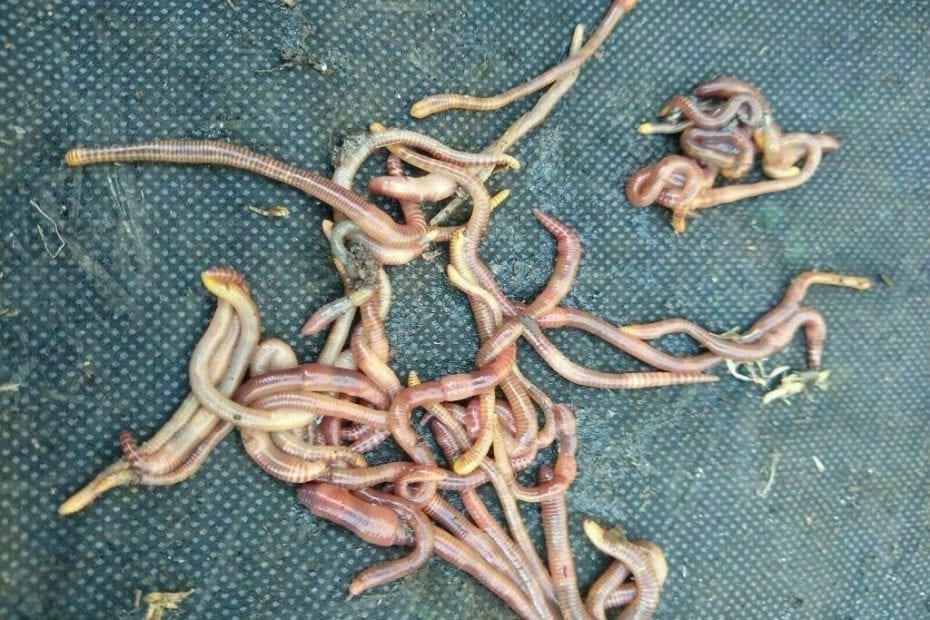
Spent coffee grounds look like ideal worm-bin food: they are finely divided, already wet, and produced every day in many kitchens. Red wigglers can help process them. The important qualification is that coffee grounds should be one part of a varied, well-bedded bin—not the bedding itself and not a bulk feedstock added all at once.
That distinction matters biologically. Eisenia fetida lives in loose, microbe-rich organic material near the surface. The worms do not simply swallow fresh scraps on contact; microorganisms begin changing those materials first, and the worms consume the softened material and its microbial community. A dense layer of damp grounds can behave very differently from a light scattering mixed through airy bedding.
Can red wigglers eat coffee grounds?
Yes, red wigglers can process spent, cooled coffee grounds in modest amounts. Oregon State University Extension lists coffee grounds and paper filters among acceptable worm-bin inputs. NC State Extension does too, while also warning that grounds add moisture and should be limited when a bin is already wet.
Research adds an important caution. In a 2021 study of spent coffee grounds mixed with straw pellets, the treatment containing 25% grounds by volume and 75% straw supported the greatest number and biomass of Eisenia andrei, a close relative of E. fetida widely used in vermicomposting research. That result shows that coffee waste can be vermicomposted successfully when it is diluted with a fibrous co-material. It does not establish 25% as a universal home-bin recipe.
Other work found reduced growth and survival of E. fetida in spent-coffee treatments, although adding cardboard reduced mortality. A recent histological study also found epidermal thinning in worms grown on coffee grounds alone and described that substrate as hostile. The practical lesson is straightforward: the mixture matters as much as the ingredient.
Are spent grounds too acidic?
“Coffee is acidic” is too simple to guide worm-bin care. Brewed coffee and the grounds left after brewing are not the same material. Brewing removes some soluble compounds, and the pH of spent grounds varies with the bean, roast, extraction method, and storage. A pH reading alone also cannot tell us whether the bin has enough oxygen, whether salts or bioactive compounds are accumulating, or whether microbial decomposition is generating heat.
I would not add lime simply because coffee was added. Unmeasured alkaline material can create a second problem instead of correcting the first. Watch the whole system: moisture, smell, temperature, texture, the rate at which food disappears, and the worms’ behavior.
A conservative way to add coffee grounds
- Use only spent grounds. Let them cool completely. Do not pour hot coffee, sweetened coffee, milk, creamer, flavored syrups, or oily additives into the bin.
- Start small. Add a thin scattering in one feeding area rather than covering the entire surface. A new or recently stressed colony should settle before you experiment with a concentrated new input.
- Mix grounds with bedding. Blend them with damp shredded paper or torn plain cardboard so the material remains porous. Ficarro Farms’ paper bedding is one current option, and the guide to preparing shredded-paper bedding explains how to moisten and loosen it.
- Bury the mixture shallowly. Place it just below the surface and cover it with bedding. This reduces drying, flies, and surface mold while keeping the feeding zone accessible.
- Wait and observe. Do not add another batch because the calendar says it is feeding day. Add more only after most of the previous food has been processed and the bin still smells earthy.
- Keep other foods in the rotation. Vegetable trimmings and other suitable scraps provide a more varied feedstock than a coffee-heavy routine.
The right amount depends on the bin’s surface area, worm population, bedding, temperature, moisture, and the other food already present. That is why I do not recommend a universal number of tablespoons per worm or cups per week. The article on how much food red wigglers can process explains why observation is more reliable than a fixed feeding claim.
When should you stop adding grounds?
Pause coffee-ground feeding if you see any of the following:
- a dark, compacted layer that stays recognizable between feedings;
- a sour, fermented, or ammonia-like odor;
- heat developing in the feeding pocket;
- liquid pooling in the bottom of the bin;
- large numbers of worms collecting on the walls or lid;
- a sudden increase in flies or dense surface mold; or
- food remaining while new material continues to accumulate.
None of these observations proves that coffee alone caused the problem. They do show that the bin is processing inputs more slowly than they are being added. Remove any obviously spoiled excess, stop feeding briefly, and restore structure with dry, loose bedding. The guides to worm-bin moisture, odor troubleshooting, and excess heat can help separate overlapping causes.
What about the paper filter?
An ordinary unbleached or plain paper coffee filter can usually go into the bin after any plastic parts, staples, or labels are removed. Tear it into pieces and treat it as a small contribution to bedding, not as enough carbon material to balance a large mass of grounds. Compostable-looking single-serve pods require more caution because “compostable” may refer to industrial composting conditions, and lids or internal components may not belong in a worm bin.
A simple classroom investigation without risking the worms
Coffee grounds make a useful lesson in experimental design because students can test the physical properties of mixtures before exposing living animals. Prepare several small, labeled cups containing equal total volumes of damp shredded paper with increasing amounts of spent grounds. Do not add worms.
Students can compare drainage, compaction, odor, temperature, and pH over several days. Each cup should receive the same amount of water and remain in the same location. The investigation does not prove which mixture is best for worms, but it shows why changing the proportion of one ingredient can alter several environmental variables at once. That is a more rigorous conclusion than treating “coffee grounds” as a single, uniform condition.
The practical answer
Red wigglers can process spent coffee grounds, but a worm bin should never become a container of coffee waste with a few worms added. Start with a small amount, combine it with loose carbon-rich bedding, keep the rest of the diet varied, and wait for the bin’s response before adding more. If the grounds accumulate, compact, smell sour, or make the bin wetter or warmer, stop and correct the habitat first.
If you are starting a colony, the current 85-count red wiggler listing is intended for a prepared bin; bedding, ventilation, moisture, and a conservative feeding plan should be ready before the worms arrive. The product was listed as in stock when this article was published, but live availability can change.
Sources
- Oregon State University Extension: Composting with worms
- NC State Extension Gardener Handbook: Composting
- Hanc et al. (2021): Conversion of spent coffee grounds into vermicompost
- Liu and Price (2011): Evaluation of three composting systems for spent coffee grounds
- Growth media change Eisenia fetida epithelium thickness