
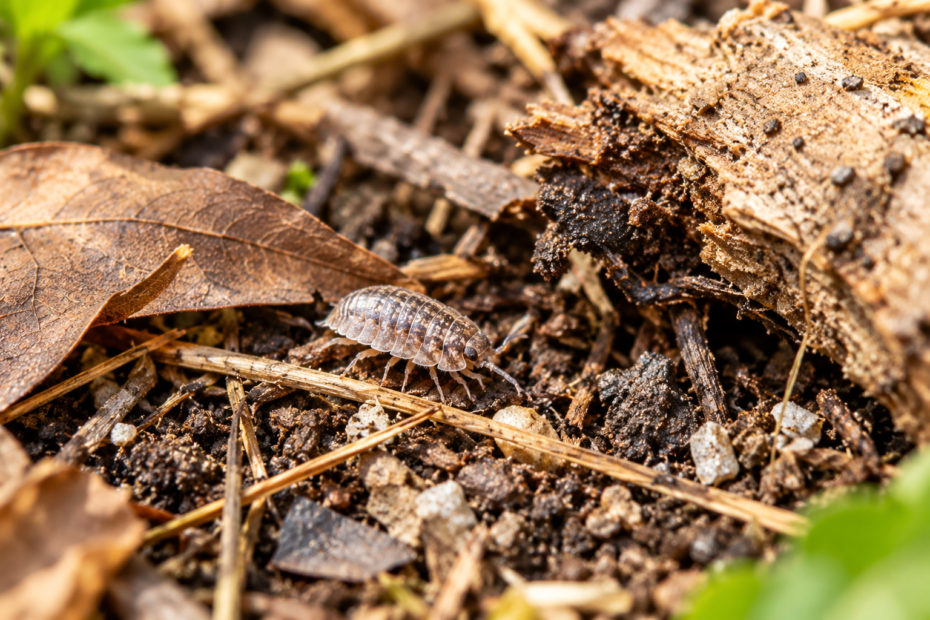
Most colonies of Armadillidium vulgare and Porcellio scaber do not need a heat mat when they are kept in an ordinary indoor room. These animals are ectotherms, so temperature matters, but “warmer” is not automatically “better.” A heater changes moisture loss, oxygen demand, activity and behavior at the same time.
The practical goal is not to force the entire enclosure to one supposedly perfect temperature. It is to prevent dangerous cold or heat while preserving a usable microclimate: a damp refuge, a less-wet area, ventilation, shelter and enough space for the animals to move away from an unfavorable spot.
Why temperature cannot be separated from moisture and oxygen
Terrestrial isopods are crustaceans whose metabolism and movement change with environmental temperature. As temperature rises, their oxygen demand can rise as well. Warm air and warm substrate also increase evaporation, which can dry the surfaces and respiratory structures the animals depend on.
This interaction is not theoretical. In a laboratory study of Porcellio scaber, animals exposed to low oxygen selected temperatures about 3°C lower than animals in normal atmospheric oxygen. Their heat tolerance and locomotor performance also declined under hypoxia. Another study found that both low humidity and low oxygen altered thermal preference in terrestrial isopods. The exact laboratory values are not household care settings, but the biological lesson is useful: temperature, hydration and ventilation work together.
Recent research on Armadillidium vulgare provides a second caution. Investigators treated 25°C (77°F) as an optimal experimental condition and 31°C (88°F) as a mild but unfavorable heat stress. At 31°C, pill bugs changed their conglobation behavior. A temperature can therefore be survivable yet still alter normal behavior. Published upper tolerance limits should never be used as enclosure targets.
When no supplemental heat is the better choice
If the room remains within normal occupied-building temperatures, the simplest arrangement is usually the safest: keep the enclosure away from direct sun, exterior-door drafts, heating vents, radiators and appliances that cycle on and off. The Armadillidium vulgare care FAQ uses ordinary indoor conditions as a starting point because no single number accounts for species, hydration, oxygen, substrate, body size and acclimation.
A slightly cool room is often easier to manage than a small enclosure with an unregulated hot spot. Cooling generally slows isopod activity; excessive heat can simultaneously increase metabolism and accelerate drying. That does not mean freezing is harmless. It means a heater should solve a measured problem, not be added merely because the animals are tropical-looking or because a piece of equipment is marketed for terrariums.
When supplemental heat may be reasonable
Supplemental heat becomes reasonable when measurements show that the enclosure repeatedly becomes much colder than the normal indoor range—for example, in an unheated classroom, garage or seasonal room—and moving the culture to a more stable location is not practical. Start by measuring the enclosure through a full day and night. A brief morning reading can miss the coldest hour, while an afternoon reading can miss a heater-driven peak.
Warming the room is preferable when possible because it changes the entire enclosure gradually. If a local heater must be used, choose a low-output unit controlled by a reliable thermostat. Place it outside one side of the enclosure rather than under the entire floor. Heating only a limited area leaves an escape route and reduces the chance that the deeper, normally cooler substrate becomes the hottest place in the habitat.
Do not place a heat source inside the enclosure. Do not allow an electrical pad, cord or connector to contact wet substrate or mist. Follow the manufacturer’s clearance and electrical-safety directions, and never bypass a thermostat because the pad “doesn’t feel very hot” to a human hand.
A safe setup checklist
- Measure first. Record temperatures at the coolest part of the night and the warmest part of the day before deciding that heat is needed.
- Use a thermostat. The controller’s probe should be secured where the warmest usable substrate or shelter actually occurs, not hanging in open air far from the heat source.
- Heat one side only. Preserve a cooler route and a damp refuge so the animals can select among conditions.
- Check more than one location. A second probe or periodic spot checks can reveal a warm edge that one centrally placed thermometer misses.
- Watch moisture after every change. A heater that appears gentle can shorten the time between water checks. Follow the moisture-gradient and misting guide rather than compensating by soaking the whole habitat.
- Keep ventilation open. Do not seal the enclosure to hold heat. The isopod respiration guide explains why damp conditions and gas exchange are both necessary.
- Test the empty enclosure. Run the complete setup for at least one day and night before animals are added, then correct hot spots, drying or thermostat cycling.
What to monitor after adding heat
Check the animals, but do not treat one behavior as a diagnosis. Repeated climbing at the coolest edge, abandonment of the heated shelter, unusual immobility, prolonged rolling up or a sudden shift into the dampest corner can all justify rechecking temperature, moisture and ventilation. The same behaviors can also have other causes.
Inspect the substrate directly. A small hygrometer can help reveal trends, but relative humidity above the substrate is not the same as moisture within it. The hygrometer guide explains what the instrument can and cannot tell you. Lift a shelter, feel the substrate at both ends and note how quickly leaf litter and supplemental food are drying.
Young mancae deserve particular attention because their small size gives them a high surface-area-to-volume ratio. A colony that appears acceptable when judged only by large adults may contain dry pockets that are less forgiving for juveniles. Preserve fine, damp refuge material without creating standing water.
Do Armadillidium vulgare and Porcellio scaber need the same setting?
No species should be reduced to one thermostat number. A. vulgare and P. scaber differ in respiratory anatomy, water-loss resistance and behavior. Body size, prior conditions and local microclimate also influence how an individual responds. Research showing a thermal preference under one humidity and oxygen treatment does not establish a universal care temperature.
For both species, a stable, ventilated habitat with a moisture gradient is more defensible than heating the entire container. If you are establishing a colony, review the isopod care checklist before adding equipment. Current Armadillidium vulgare 10-count packs and Porcellio scaber 10-count packs are available when in stock; prepare and test the habitat before the animals arrive.
A useful classroom application
Teachers can turn enclosure preparation into a measurement exercise without exposing animals to experimental heat. Place probes at the proposed warm edge, center and cool refuge of an empty habitat. Record temperature at fixed intervals for 24 hours, then graph the three locations. Students can identify the daily maximum, minimum, range and thermostat cycling before any isopods are introduced.
This preliminary map teaches an important principle: a container does not have one temperature. It has a thermal landscape. The best setup is not the one that produces the highest reading; it is the one that avoids dangerous extremes while preserving choices among usable microclimates.
Research sources
Sztruhala, Horváth and Herczeg (2026) tested how stable and fluctuating heat treatments affected risk-taking behavior in Armadillidium vulgare.
Antoł and colleagues (2019) measured thermal preference, running performance and heat tolerance in Porcellio scaber under normal and low oxygen.
Antoł, Berg and Verberk (2021) examined body size, lung type, desiccation resistance, hypoxia tolerance and thermal preference in terrestrial isopods.
Sutton and colleagues (2018) reviewed species-specific behavioral responses to temperature and humidity, including aggregation in A. vulgare and P. scaber.