
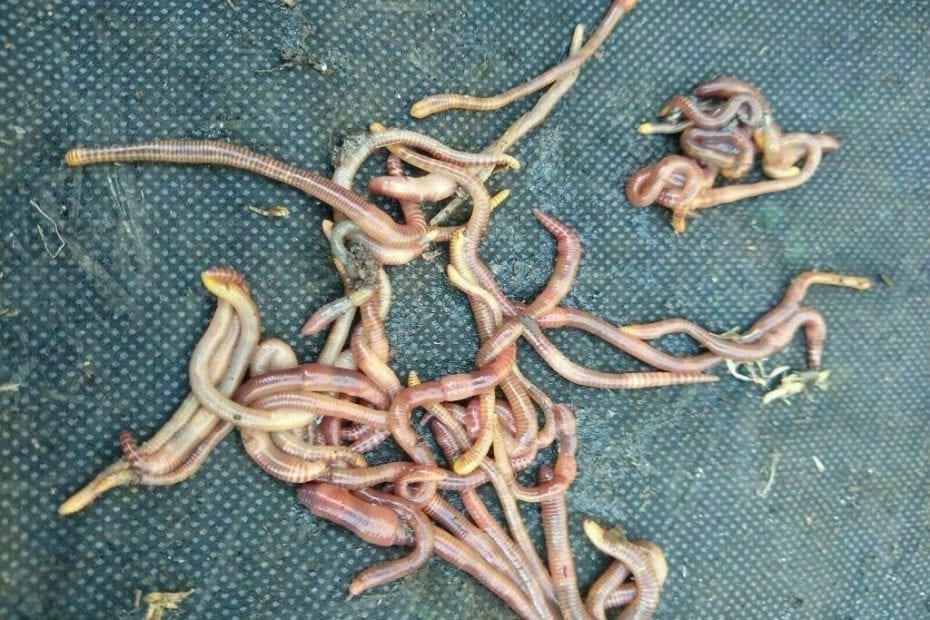
A worm bin is not a container holding only worms. It is a small decomposer ecosystem: bacteria and fungi soften organic matter, red wigglers graze through that microbially active material, and many tiny invertebrates occupy the same moist habitat. Mites are among the organisms most often noticed—and most often misinterpreted.
Seeing a few mites on a food scrap or along the bedding surface usually does not mean the bin is failing. A sudden, dense population is more useful as a management signal. It often tells us that food is accumulating faster than it is being processed, the bedding is too wet, or air movement and drainage are inadequate.
What are the tiny creatures in the bin?
Mites are arachnids, not insects. Most are oval or rounded and so small that a hand lens is helpful. Adults and nymphs usually have eight legs, while the youngest larval stage commonly has six. Mites move by walking; they do not jump or fly. Their colors vary widely, so white, tan, brown, orange, or red is not enough by itself to identify a species or decide whether it is harmful.
Two common look-alikes are easy to separate behaviorally:
- Springtails are tiny insects that often jump when disturbed. They favor damp organic material and are usually harmless decomposers.
- Potworms are slender, pale, segmented worms. They may become conspicuous in moist or acidic bedding, but they are not mites and usually do not injure red wigglers.
If an organism is too small to examine, call it an unidentified bin arthropod rather than making a confident species diagnosis from color alone. That is the scientifically honest starting point.
Are mites harmful to red wigglers?
Most mite sightings in a home worm bin are not an emergency. Mites include detritivores that consume decaying material, predators that eat other tiny organisms, and species with other feeding habits. Extension guidance describes mites as normal inhabitants of manure and other organic materials, and a modest population can occur in a healthy bin.
The important distinction is not simply “mites present” versus “mites absent.” Instead, ask three questions:
- Are the worms active in the bedding and responsive when uncovered?
- Does the bin smell earthy rather than sour or putrid?
- Is most of the previous feeding disappearing before more food is added?
If the answers are yes and mites are present only in small numbers, observation is usually enough. A population explosion—mites massed over food, walls, and the bedding surface—deserves attention because very high numbers can stress worms and often accompany poor bin conditions.
Some references describe a red mite associated with earthworm beds that may attach to worms or affect cocoons. That possibility is real, but “red” is not a diagnosis; many harmless mites are reddish. Concern is more justified when mites are repeatedly attached to worms or cocoons, the worms are declining, and the bin remains unhealthy after moisture and feeding are corrected. In that uncommon situation, isolate a small sample, examine it under magnification, and seek identification help from a local Cooperative Extension office or an experienced invertebrate diagnostician.
Why mite populations suddenly increase
Dense mite populations are commonly associated with three overlapping conditions:
- Overfeeding. Large quantities of scraps remain in the bin long enough to ferment or spoil, creating concentrated feeding sites for mites.
- Excess moisture. Water-rich foods, frequent misting, or poor drainage can leave the bedding soggy. A healthy bin should be moist and springy, not saturated or dripping.
- Limited aeration. Compacted bedding and standing water reduce oxygen. Red wigglers require moist skin, but they also require oxygen; wet and airless are not the same as properly moist.
These conditions reinforce one another. Excess food releases water as it decomposes. Wet bedding mats. Matting and waterlogging restrict air spaces, slowing aerobic decomposition and leaving even more food available. The mites are often the visible symptom of that larger imbalance.
For a closer moisture check, see How Wet Should a Worm Bin Be?. If standing water or oxygen loss is the concern, Can Red Wigglers Drown? explains why saturation becomes dangerous. Persistent odor is another useful clue; the troubleshooting steps in Why Does My Worm Bin Smell Bad? address the same underlying processes.
A safe, measured response
The goal is not to sterilize the bin. It is to restore conditions that favor the worms and a balanced decomposer community.
- Pause feeding. Stop adding food for several days, or longer if substantial scraps remain. Healthy red wigglers tolerate a short feeding pause far better than a growing mass of sour food.
- Remove obvious excess. Lift out spoiled, strongly fermented, or moldy clumps that the worms have not entered. There is no need to discard the entire bin.
- Correct the moisture. Mix in dry shredded cardboard or uncoated paper a little at a time. Fluff compacted zones gently so air can move through the bedding. The shredded-paper bedding guide explains how to prepare it.
- Improve airflow and drainage. Make sure ventilation openings are clear and no liquid is pooling at the bottom. Do not leave the worms exposed to direct sun or drying wind.
- Resume with smaller feedings. Add one modest pocket of food and wait until most of it is processed before adding more. The realistic limits described in How Much Food Can Red Wigglers Process? are more reliable than feeding by a fixed daily schedule.
It may take a week or more for a conspicuous mite population to decline. Judge progress by the whole bin: less leftover food, a clean earthy smell, loose moist bedding, and active worms are more informative than trying to count every mite.
What not to do
- Do not use pesticides, insecticidal soap, bleach, or household cleaners. A treatment toxic to mites can also harm worms and the microorganisms that make vermicomposting work.
- Do not flood the bin. Drowning or washing out mites also removes cocoons, microbes, and fine bedding while worsening oxygen loss.
- Do not heat or sun-bake the culture. Direct sun can quickly overheat and desiccate red wigglers.
- Do not add lime blindly. Acidity may contribute to some problems, but color-changing powders are not a substitute for measuring pH and correcting excess food, moisture, and poor aeration first.
- Do not throw away a productive culture merely because a normal decomposer appeared. Correct the habitat before replacing the worms.
A useful classroom observation
A mite sighting can become a careful study of ecological indicators. With a hand lens, students can compare three small samples from the same bin: the surface near fresh food, the bedding several centimeters away, and a deeper zone. Record organisms by broad category—walking mites, jumping springtails, segmented potworms, and red wigglers—along with moisture, odor, and visible food.
Repeat the observations after feeding is paused and dry bedding is added. The exercise connects animal behavior, decomposition, moisture, and oxygen without requiring students to kill or chemically treat any organism. It also teaches an important habit of science: first describe what changed, then test the simplest environmental explanation.
The practical conclusion
A few mites are usually part of the system, not evidence against it. A sudden abundance is a cue to examine feeding rate, moisture, airflow, and drainage. Correct those conditions patiently, avoid harsh treatments, and watch the worms themselves. Their activity and the condition of the bedding are the best measures of recovery.
If you are establishing a new culture, begin with the habitat rather than the livestock: the step-by-step worm-bin setup guide covers bedding, moisture, and feeding before worms are added. Ficarro Farms also offers 125 live red wigglers for appropriately prepared bins.