
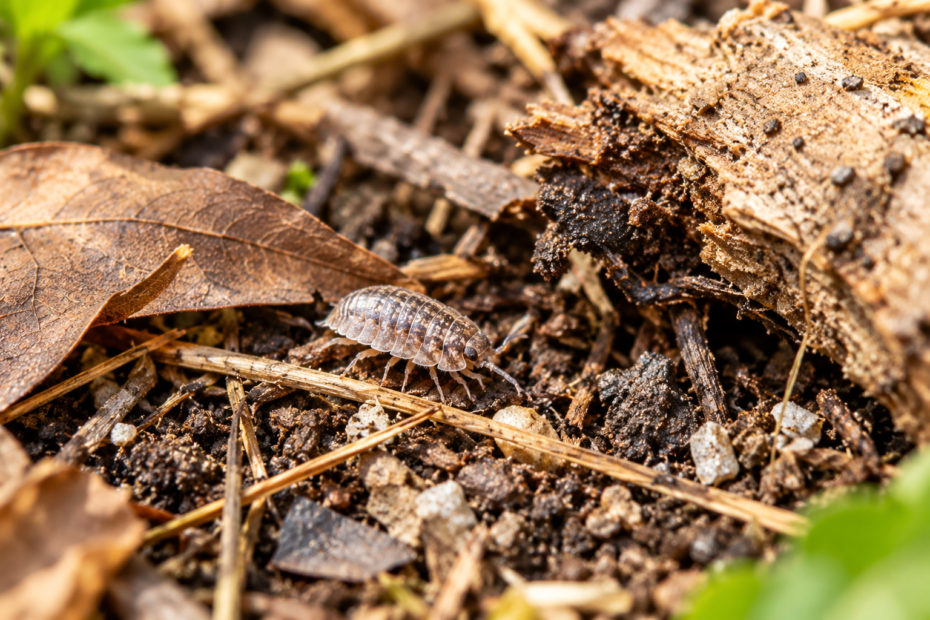
When pill bugs or sowbugs disappear beneath bark, leaf litter, or a flat piece of cover, they are not merely being secretive. A shelter changes the animal’s immediate environment. It reduces light, increases contact with surrounding surfaces, and can create a more stable pocket of moisture and temperature than the exposed surface beside it.
That makes shelter one of the simplest and most useful parts of an isopod enclosure. It also makes shelter use easy to misread. A crowded hide may reflect moisture, darkness, surface contact, social attraction, or several of those factors at once. It is a biological signal worth observing, but it is not a one-step diagnostic test.
Why shelter matters to a terrestrial crustacean
Terrestrial isopods still face the problem of water loss. Their respiratory structures are located on abdominal appendages called pleopods, and their success on land depends partly on behavior that limits exposure to dry conditions. The practical connection between isopod respiration, moisture, and ventilation is why a good enclosure needs both access to damp microhabitats and enough air exchange to avoid stagnant, saturated conditions.
Controlled research supports this shelter–microclimate connection. In experiments with Porcellio scaber and Armadillidium vulgare, animals spent more time sheltering under lower relative humidity and more time feeding or moving under higher relative humidity. That does not mean every hidden animal is dehydrated. It means the balance between sheltering and foraging changes with environmental conditions.
Species also differ. A grassland study found that P. scaber sheltered more than A. vulgare under the study conditions. A recent field experiment with P. scaber and Armadillidium versicolor confirmed that artificial shelters were used unevenly and that activity was concentrated at night and dawn. These results are a good reason not to interpret one species by using another species as an exact behavioral template.
Contact and darkness are part of the shelter
A flat shelter gives an isopod close contact with surfaces above and below it. This contact-related response is often described as thigmotaxis or thigmokinesis. In plain language, the animal’s movement changes when its body encounters enclosing surfaces. The result is familiar to anyone who lifts a piece of bark and finds isopods pressed into the small space beneath it.
Darkness also matters, but light is not the entire explanation. Laboratory groups of woodlice commonly selected a shelter and often concentrated beneath one of two otherwise similar choices. Research on aggregation shows that social interaction helps amplify that choice. Once some animals occupy a suitable refuge, others may join them rather than distribute themselves evenly.
This is why a pile of isopods under one hide does not prove that the other side of the enclosure is unsuitable. The first group can influence the next animal’s decision. For a fuller explanation of that social effect, see why pill bugs cluster together.
What makes a useful enclosure shelter?
A practical shelter should create cover without becoming a trap. Good options include clean, untreated cork bark, a stable piece of natural bark from a known untreated source, a piece of clay pot, or another animal-safe object with a broad lower surface. The material should lie securely enough that routine movement or a light bump will not crush animals beneath it.
- Use more than one covered area. Placing shelters across the enclosure lets animals use different parts of the moisture gradient.
- Keep the shelter accessible. A flat piece that can be lifted gently is easier to inspect than a deep, unstable stack.
- Avoid chemically treated material. Paint, preservatives, pesticide exposure, and an unknown collection history add unnecessary uncertainty.
- Do not seal the entire surface. Isopods still need access to leaf litter, food, open substrate, and ventilated space.
- Check beneath cover without constant disturbance. Repeated lifting changes light, airflow, contact, and group position—the same conditions you are trying to observe.
Shelter should work with a moisture gradient, not replace it. One refuge can overlap the reliably damp zone while another extends into the less-wet portion of the enclosure. The goal is to give the animals choices. The guide to misting an isopod enclosure explains why observing the habitat is more useful than following a fixed spray schedule.
How to read shelter use without overreacting
Look for patterns across time rather than treating one inspection as a verdict.
- If nearly every animal is packed beneath the dampest cover while the rest of the substrate is dry, check the moisture gradient.
- If animals leave cover mainly after the room darkens, that can fit normal nocturnal activity.
- If food remains untouched in exposed areas, consider whether dryness, bright light, heat, or recent disturbance is limiting foraging.
- If one shelter is repeatedly empty, compare its moisture, temperature, darkness, stability, and location before deciding the animals “dislike” its material.
- If the habitat is saturated, smells bad, or has standing water, do not interpret hiding as proof that conditions are good. Correct the enclosure conditions.
These observations help narrow the questions to ask; they do not identify one cause by themselves. A hidden animal can be resting, avoiding exposure, molting, joining a group, or responding to a local microclimate.
A careful classroom observation
Shelter use can become a strong lesson in experimental design without exposing animals to extreme conditions. Give each group two identical shelters in the same enclosure. Keep shelter size, material, darkness, substrate, and moisture as similar as possible. Place the isopods in the center, allow a defined settling period, and record the number beneath each shelter and outside at fixed intervals.
Then reverse the left and right positions and repeat the observation. If the group still concentrates under one shelter, students should not immediately call it a side preference. Social aggregation can produce an uneven distribution even when the shelters are equivalent. Multiple groups and repeated trials are more informative than one choice.
This exercise connects behavior, microclimate, and cautious inference. Students can ask what was controlled, what was measured, and whether the animals acted as independent data points. Teachers planning several stations can use the classroom isopod count guide before ordering.
Prepare the habitat before the animals arrive
A shelter belongs in the enclosure from the beginning, along with suitable substrate, leaf litter, a dependable moisture gradient, ventilation, and a care plan. The first isopod colony guide provides a practical setup and arrival checklist. When the habitat is ready, you can compare current live isopod listings by species and count. Animal listings do not include a complete habitat unless the product page explicitly says so.
Sources and limits
- Fialová R, Tuf IH. “Spatial activity and sheltering behaviour of terrestrial isopods (Isopoda, Oniscidea): a field experiment.” ZooKeys. 2025;1225:127–139. doi:10.3897/zookeys.1225.125030.
- Dias N, Hassall M, Waite T. “The influence of microclimate on foraging and sheltering behaviours of terrestrial isopods.” Pedobiologia. 2012;55:137–144. doi:10.1016/j.pedobi.2011.10.003.
- Broly P, Mullier R, Deneubourg J-L, Devigne C. “Aggregation in woodlice: social interaction and density effects.” ZooKeys. 2012;176:133–144. Open-access article.
- Hassall M, Tuck JM. “Sheltering behavior of terrestrial isopods in grasslands.” Invertebrate Biology. 2007;126:46–56. doi:10.1111/j.1744-7410.2007.00075.x.
The studies support links among sheltering, microclimate, species, activity timing, and social behavior. They do not establish one universally best shelter material, size, number, or placement for every captive species and enclosure.