
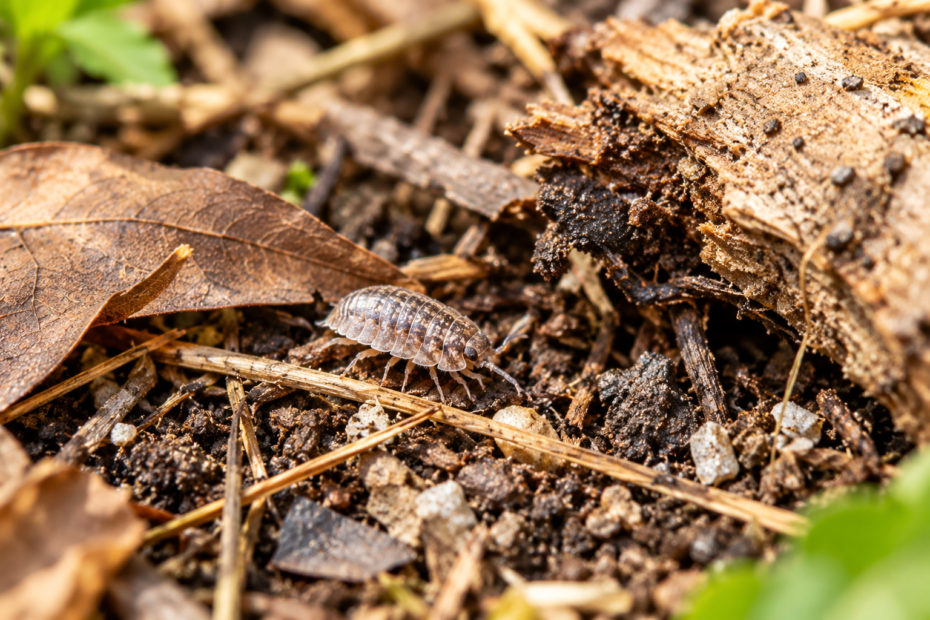
A pill bug that suddenly rolls into a tight ball is not simply “playing dead.” A sowbug that stops moving after a disturbance is not necessarily sick. These animals have several defensive behaviors, and the response you see depends on the species, the kind of disturbance, and the individual animal.
The two behaviors most often confused are conglobation—curling the body into a protective ball—and tonic immobility—remaining temporarily motionless after a disturbance. Understanding the difference makes ordinary enclosure observations more meaningful and helps teachers design a behavior activity without repeatedly stressing the animals.
Conglobation: rolling the body into armor
Armadillidium vulgare, the common pill bug or roly-poly, can bend its segmented body into an almost complete sphere. In full conglobation, the legs, antennae, and softer underside are largely enclosed by the hardened dorsal plates. That posture makes it difficult for a predator to reach the vulnerable ventral surface.
Conglobation also has a second benefit. In a controlled respirometry study, conglobated A. vulgare lost water more slowly than extended animals under dry conditions. The authors concluded that rolling up can help conserve water as well as provide physical protection. It is therefore better to think of the ball as a multifunctional posture, not a single-purpose reflex.
The time an animal stays rolled up is not fixed. A 2023 experiment found that male A. vulgare exposed to chemical cues from a predator remained conglobated longer than males exposed to non-predator cues or water. Another study found that an individual’s recent state influenced how long it remained rolled after repeated stimulation. Those results are a useful warning against treating one observation as a permanent species trait.
Tonic immobility: becoming still after disturbance
Tonic immobility is a temporary reduction in movement following a mechanical disturbance. It is sometimes called death-feigning, although that label can imply more certainty about function than a classroom observation can establish. In terrestrial isopods that cannot form a complete ball, the animal may contract its body slightly, draw in its legs, hold its antennae close, and remain still.
Porcellio scaber, the common rough woodlouse or sowbug, is a good example. Its flatter body does not close into the nearly complete sphere made by A. vulgare. In experiments, some P. scaber showed tonic immobility, but most individuals tried to run away instead. Researchers also found consistent individual differences in the duration of immobility. In other words, two healthy sowbugs may respond differently to the same disturbance.
This is why “freeze” and “roll up” should not be used as interchangeable descriptions. Conglobation describes body form. Tonic immobility describes a period of reduced responsiveness. A pill bug can be both tightly rolled and motionless, while a sowbug can become motionless without forming a ball.
Why one isopod freezes and another runs
There is no single response that every terrestrial isopod uses. Research on antipredator behavior describes several strategies, including conglobation, clinging closely to a surface, rapid escape, chemical secretion, aggregation, and tonic immobility. Body structure matters: a “roller” is built differently from a flatter “clinger.” The intensity and type of disturbance matter too.
That variation has practical consequences:
- Species matters. A. vulgare is a reliable species for observing conglobation. P. scaber is more likely to run or press against a surface, although some individuals become motionless.
- Individuals differ. Response strength and duration can vary even within one species.
- Context matters. Recent disturbance, temperature, moisture conditions, cover, and perceived risk can influence behavior.
- Repeated handling changes the question. Once an animal has been stimulated several times, you may be measuring its response to repeated disturbance rather than its typical first response.
A brief freeze after handling is therefore not, by itself, evidence of illness. It is equally important not to dismiss persistent unresponsiveness. If an isopod does not resume normal movement after being returned to a suitable, humid refuge, check for excessive dryness or heat, recent chemical exposure, injury, and whether the animal is molting. Avoid probing it repeatedly to obtain a reaction.
A low-stress way to observe defensive behavior
You do not need to squeeze, drop, or repeatedly poke an isopod to make a useful observation. Those methods may appear in controlled research, but they are not necessary for a classroom comparison.
- Prepare a clear observation cup with a small piece of slightly damp paper or familiar substrate.
- Move one isopod with a soft brush, folded index card, or spoon. Do not pinch it with forceps.
- Record its immediate response to the ordinary transfer: roll, run, cling, remain still, or another clearly defined behavior.
- Observe quietly for no more than a minute or two. Record the first movement if the animal became still or rolled up.
- Return it to a shaded, humid refuge before observing another animal.
One transfer per animal is enough for a descriptive activity. Do not continue until every animal produces the response you expected. “No roll” or “ran immediately” is valid data, not a failed trial.
Turning the observation into a sound classroom comparison
A simple comparison of A. vulgare and P. scaber can reveal how anatomy and behavior work together. Before beginning, define categories that students can recognize consistently: fully rolled, partly curled, motionless but not rolled, running, clinging, and other. Use the same cup, transfer method, observation period, and damp substrate for both species.
Have one student handle the animals while another records the behavior. If practical, the recorder should not know which result the group expects. Record each individual only once, then compare proportions rather than forcing every response into a yes-or-no “played dead” category.
The conclusion should remain narrow: under these observation conditions, one group displayed a behavior more or less often. The activity cannot prove what an animal was “thinking,” establish how it would respond to a real predator, or determine a universal response for the species. That restraint is part of good science.
Choosing pill bugs or sowbugs for observation
If the goal is to observe a clear rolling posture, Armadillidium vulgare is the more direct choice. If the goal is to compare different body forms and defensive strategies, pair it with Porcellio scaber. Our pill bug versus sowbug classroom guide explains the practical differences, and the classroom count guide helps plan observation groups without crowding the containers.
Behavior is easiest to interpret when the animals have appropriate shelter and moisture. See why isopods hide and how to test moisture preference fairly before turning an enclosure observation into a conclusion about defense.
Sources
- Zamora-Camacho, F. J. (2023). Keep the ball rolling: sexual differences in conglobation behavior of a terrestrial isopod under different degrees of perceived predation pressure. PeerJ, 11, e16696.
- Smigel, J. T., & Gibbs, A. G. (2008). Conglobation in the pill bug, Armadillidium vulgare, as a water conservation mechanism. Journal of Insect Science, 8, 44.
- Matsuno, H., & Moriyama, T. (2012). Behavioral evidence for internal factors affecting duration of conglobation in pill bugs. Acta Biologica Hungarica, 63(Suppl. 2), 80–82.
- Tuf, I. H., Drábková, L., & Šipoš, J. (2015). Personality affects defensive behaviour of Porcellio scaber. ZooKeys, 515, 159–171.
Related reading: why pill bugs cluster together and how to tell male and female isopods apart.