
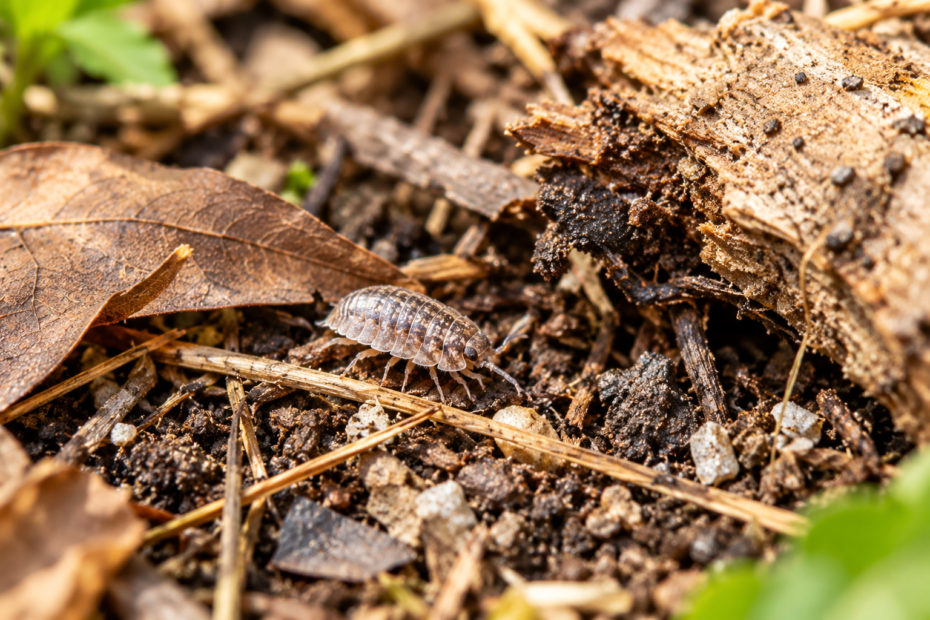
A pill bug is not old simply because it is large, and a small sowbug is not necessarily young. Terrestrial isopods continue to grow through repeated molts, while food, temperature, moisture, sex, reproductive history, and local habitat all influence how quickly that growth occurs. Lifespan is therefore best understood as a range produced by biology and conditions—not as an expiration date attached to a species name.
That distinction matters in a classroom colony and in long-term care. A mixed-age culture can remain active for years even though individual animals enter and leave the population at different times. It also prevents a common mistake: assuming that an animal purchased as an adult has a known birthday or a predictable amount of life remaining.
How long can Armadillidium vulgare live?
The strongest field evidence comes from a long-term California grassland study of Armadillidium vulgare, the common pill bug. Most animals in that population belonged to the one- and two-year age classes, while survival to age four was rare. That does not mean every captive pill bug should live four years. It means that a few animals in a particular wild population survived that long, while most did not.
Work on British populations reached a similarly important conclusion from another direction: reproductive timing changed with habitat and growth conditions. Many females reproduced at about 23 months, some produced another brood at about 35 months, and under unusually favorable conditions some reproduced at about 11 months. The biology was flexible rather than governed by one universal calendar.
More recent research has also detected age-related physiological changes in A. vulgare, including changes in immune-cell characteristics and other biomarkers used to study senescence. Pill bugs do age biologically; the difficulty is that we cannot read that age accurately from color or body length alone.
What about Porcellio scaber?
Porcellio scaber, the common rough sowbug, follows the same general pattern of gradual postembryonic development and continued molting, but it should not be treated as an interchangeable version of A. vulgare. A developmental study reported that P. scaber reached mature male form after roughly eight months under laboratory conditions and about eleven months in nature. Another individual-based laboratory study followed animals for 90 weeks and discussed a laboratory longevity of roughly three years.
Those numbers describe particular study conditions. They are useful for understanding scale—development takes months and a healthy animal may live for years—but they are not a guarantee for a home or school culture.
Why size does not reveal exact age
Isopods add size in steps as they molt. Growth can slow when food quality is poor, moisture is unsuitable, temperatures are low, animals are crowded, or reproduction redirects a female’s energy. Two animals of the same age can therefore differ substantially in size, and two animals of similar size can have different histories.
For practical purposes, use broad life stages rather than invented ages:
- Mancae: newly independent young that have left the female’s brood pouch and initially lack the final pair of walking legs.
- Juveniles: small animals developing adult structures over successive molts.
- Adults: sexually mature animals; adult size still varies with species, sex, nutrition, and individual history.
Our guide to baby isopods and mancae explains the earliest stage, while the article on distinguishing male and female isopods shows why adult anatomy is more informative than body color or size.
What supports a longer, healthier life?
Good husbandry cannot guarantee longevity, but it can remove preventable stresses. Maintain a moisture gradient instead of making the entire enclosure uniformly wet, provide ventilation without drying the refuge, keep decaying leaves available as a foundational food, and offer stable shelter. Avoid repeated handling merely to check whether an animal is alive or “fully grown.”
The biological reasons are connected. Isopods rely on specialized abdominal respiratory structures, so moisture and ventilation must work together. They also use shelter to reduce exposure and manage their immediate microclimate; our guide to isopod sheltering behavior explains why a hide is more than decoration. Molting remains important throughout life, and the temporary two-toned appearance described in our biphasic-molting guide is normal rather than a sign that an animal has reached a particular age.
A better classroom way to study age structure
Students can study a colony’s age structure without assigning false birthdays. Once a week, count animals in broad size classes—mancae, small juveniles, larger juveniles, and adults—using the same observation area and the same amount of search time. Record molts, visible broods, and changes in the proportion of each class.
This becomes a longitudinal population study rather than a one-day guessing exercise. Students can ask whether a rise in mancae is followed by an increase in juveniles, whether the apparent adult fraction changes through the semester, and how observation method affects the count. Animals should remain in or immediately above their habitat, and the study should not require marking, chilling, or prolonged isolation.
For a small observation group, Ficarro Farms currently offers 10-count Armadillidium vulgare and 10-count Porcellio scaber. For a semester population study, begin with the number the class actually needs rather than relying on reproduction to reach a deadline.
The practical answer
Armadillidium vulgare and Porcellio scaber can live for years, but “two to three years” or “up to four years” should be treated as context, not a promise. Wild survival, laboratory longevity, and the future of one captive animal are different questions. The most scientifically honest answer is a range accompanied by the conditions and population from which it came.
Research sources
- Paris & Pitelka — Population characteristics of Armadillidium vulgare in California grassland
- Dangerfield & Hassall — Phenotypic variation in the breeding phenology of Armadillidium vulgare
- Antoł and colleagues — Armadillidium vulgare as a model for studying cellular senescence
- Tomescu & Crăciun — Postembryonic development in Porcellio scaber
- Zimmer — Postembryonic development in Porcellio scaber: the significance of food