
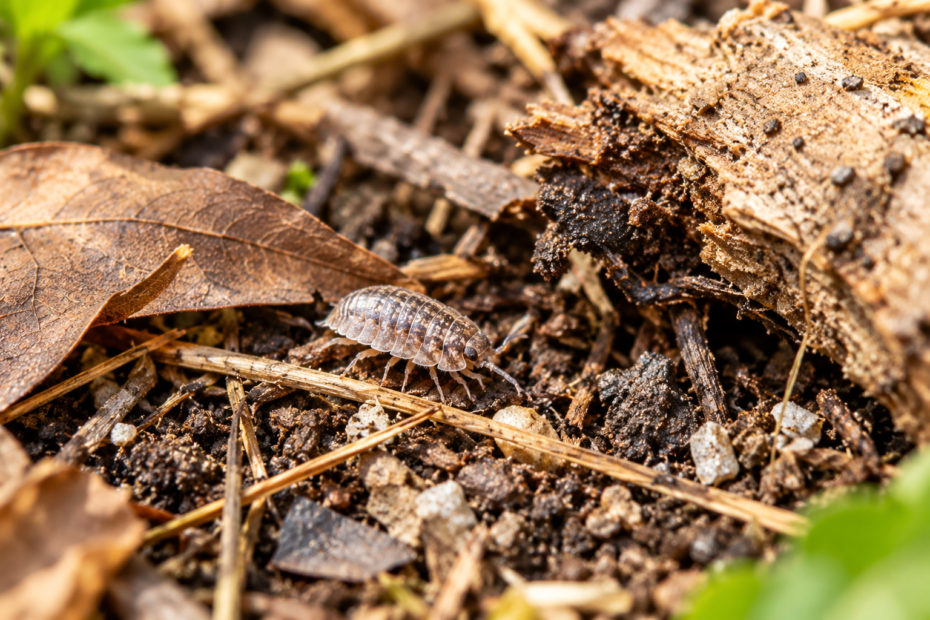
A pill bug’s speed is not a fixed species constant. The same animal may walk steadily across a familiar surface, pause in an exposed arena, turn repeatedly near a wall, or roll up after a rough transfer. Temperature, body size, hydration, light, substrate, species, and recent disturbance can all change the movement you observe.
That variability is exactly what makes locomotion useful in the classroom. Students can measure distance and time, calculate speed, describe variation among individuals, and learn why a biological measurement is meaningful only when the conditions are defined carefully.
What “speed” means in a pill bug study
Speed is distance divided by time. If an isopod travels 10 centimeters in 20 seconds, its average speed over that measured interval is 0.5 centimeters per second. The calculation is simple; deciding what the number represents is the more interesting scientific problem.
A short classroom trial does not measure the animal’s maximum possible speed, its daily travel distance, or a permanent trait. It measures how quickly that individual crossed a particular track under the conditions used that day.
Research makes the importance of those conditions clear. In Porcellio laevis, measured running speed changed with temperature and body mass, while substantial water loss eventually reduced locomotor performance. Experiments with Porcellio scaber likewise found that temperature and oxygen conditions altered running performance. A field-and-laboratory study of Armadillidium vulgare documented impressive walking distances, but those results came from long observations under specific light and temperature conditions—not from a brief classroom sprint.
The practical lesson is not that students need elaborate equipment. It is that they should keep ordinary variables as consistent as possible and avoid presenting one trial as “how fast pill bugs move.”
A humane classroom locomotion lab
This activity measures voluntary walking over a short distance. It does not require heating or chilling the animals, drying them, shining a hot lamp on them, or repeatedly touching them to force continuous movement.
Materials
- A shallow clear container with straight sides
- A removable paper track marked at 0 and 10 centimeters
- A second paper strip beneath or beside the track for recording position marks
- A stopwatch or phone timer
- A soft paintbrush, index card, or spoon for transfers
- A small ventilated holding cup with familiar, slightly damp substrate
- One data sheet per group
- Five to ten isopods of the same species, if possible
Use paper that is slightly damp but not wet enough to leave standing water. A very dry surface changes the animal’s water balance; a soaked surface changes traction and creates another variable. Keep the arena away from direct sun and hot lamps.
Procedure
- Place the track in the container and let it reach room conditions before the animals are introduced.
- Record the room temperature. If different groups work in different places, also note obvious differences in light and surface conditions.
- Transfer one isopod gently to the starting area. Cover it loosely with a small opaque cup for about 30 seconds so the release procedure is consistent.
- Lift the cup without touching the animal and start the timer when the isopod’s front end crosses the zero line.
- Stop the timer when the front end crosses the 10-centimeter line.
- If the animal stops, rolls up, or does not cross within two minutes, record “no completion” rather than prodding it down the track.
- Return the animal to the humid holding cup and test a different individual.
- Wipe or replace the paper between groups if it becomes soiled or unevenly wet.
One measured crossing per animal is enough for an introductory lab. If students repeat trials, allow a recovery period and randomize the order so the same individuals are not always tested first or last.
Record more than a stopwatch time
A useful data table includes:
- Animal number
- Species
- Approximate size class: small, medium, or large
- Time to cross 10 centimeters
- Calculated speed
- Whether the animal completed the track
- Observed behavior: straight walk, repeated turning, wall-following, pause, partial curl, or full conglobation
Completion rate matters. If only three of ten animals crossed the track, reporting the mean speed of those three without mentioning the other seven gives an incomplete picture. The animals that paused or rolled up did not “fail”; they displayed a different response to the test environment.
How students should analyze the results
Calculate each completed trial separately:
Average speed = 10 cm ÷ crossing time in seconds
Then summarize the group with a median as well as a mean. The median is often useful when one especially fast or slow trial pulls the mean away from most observations. Students can also report the range and the fraction of animals that completed the track.
For example, a careful conclusion might read:
Under our classroom conditions, six of eight pill bugs crossed the 10-centimeter track within two minutes. Completed trials had a median speed of ___ centimeters per second. The remaining two animals stayed near the start, so our speed summary applies only to the animals that completed the track.
That statement is more scientifically honest than claiming that every pill bug moves at one speed.
Variables that can distort a comparison
- Temperature: Isopods are ectotherms, so room and surface temperature can change locomotor performance. Do not compare a sun-warmed track with a shaded one.
- Species: Armadillidium vulgare can roll into a ball, while Porcellio scaber is more likely to run, cling, or remain still. A species comparison includes differences in body form and defensive strategy.
- Body size: Larger and smaller animals may differ in stride and speed. Record size instead of assuming it is irrelevant.
- Moisture: Unevenly wet paper can create both a traction difference and a habitat choice.
- Walls: Many isopods follow edges. A narrow track may measure wall-following as much as forward locomotion.
- Handling: A pinched, dropped, or repeatedly touched animal is responding to disturbance. Standardize a gentle transfer and give the animal time to settle.
- Time of day: Terrestrial isopods are often more active under darker, cooler conditions. Groups tested at very different times should not be pooled without noting that difference.
A stronger follow-up question
Once students understand the basic measurement, they can ask whether the method itself changes the result. For example, compare a wide open arena with a corridor of the same length, or compare the first half and second half of a longer track. Keep moisture, light, temperature, surface, and handling the same.
The goal is not to make the animal run faster. It is to investigate whether the apparatus changes what is being measured. This is an excellent introduction to experimental design because students can see that instruments and procedures are part of the biological observation, not neutral background.
Choosing animals for the activity
For a straightforward first trial, use one species and similar-sized animals. Armadillidium vulgare works well when students will also discuss conglobation, while Porcellio scaber offers a useful comparison in body shape and escape behavior.
Before planning group sizes, see how many pill bugs a classroom lab needs. The pill bug lab supplies checklist helps with arrival and setup, and the post-shipping rest guide explains why newly delivered animals should settle before a behavior measurement.
For interpretation, compare this activity with our guides to freezing and rolling behavior, light-versus-dark testing, and moisture-preference experiments. Together, they show why movement can be a response, a performance measure, or a route toward a preferred condition—and why those are not automatically the same question.
Sources
- Dailey, T. M., Claussen, D. L., Ladd, G. B., & Buckner, S. T. (2009). The effects of temperature, desiccation, and body mass on the locomotion of the terrestrial isopod, Porcellio laevis. Comparative Biochemistry and Physiology Part A, 153(2), 162–166.
- Antoł, A., Rojek, W., Singh, S., Piekarski, D., & Czarnoleski, M. (2019). Hypoxia causes woodlice (Porcellio scaber) to select lower temperatures and impairs their thermal performance and heat tolerance. PLOS ONE, 14(8), e0220647.
- Furukawa, T., Mizushima, M., Horinosono, S., & Karasawa, S. (2017). Estimation of the walking ability of an exotic terrestrial isopod Armadillidium vulgare by field and laboratory measurements. Edaphologia, 101, 27–32.
- Wright, J. C., & O’Donnell, M. J. (2014). The amazing ecology of terrestrial isopods. Science and Children, 51(7), 60–64.