
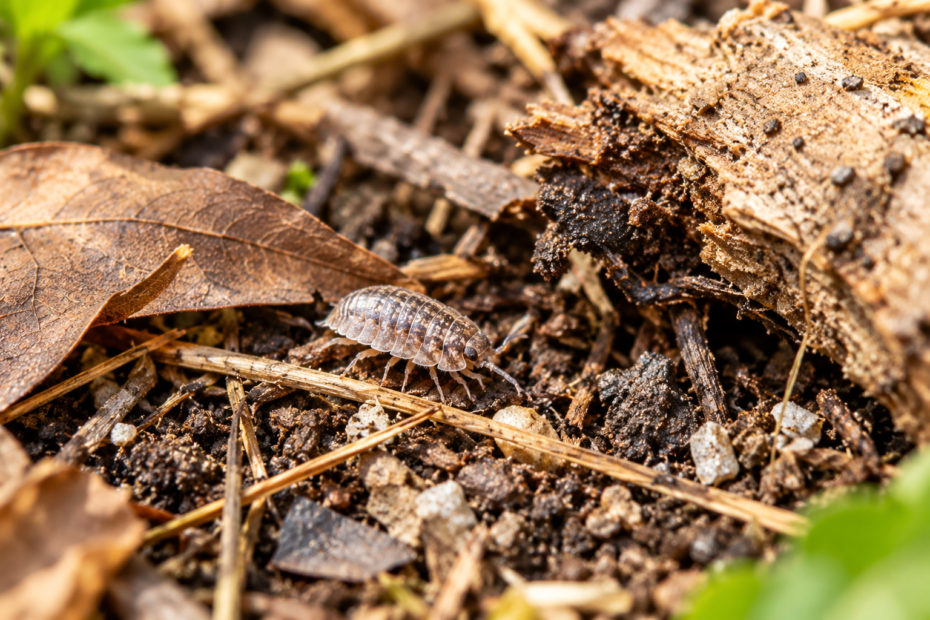
As winter approaches, pill bugs and sowbugs become harder to find. That does not mean they have vanished, and it does not mean every animal has entered a single, fixed state that is equivalent to mammalian hibernation. Terrestrial isopods survive winter by combining behavior, sheltered microhabitats, seasonal physiological change, and reduced activity.
For anyone keeping Armadillidium vulgare or Porcellio scaber, that biology matters for a practical reason: cold tolerance is not the same thing as cold preference. A wild population may endure winter beneath leaf litter or soil, but a captive colony does not benefit from being chilled or allowed to freeze.
Do pill bugs hibernate?
“Hibernate” is useful everyday language, but it can oversimplify what is happening. Many pill bugs and sowbugs overwinter as adults and spend long periods inactive in protected sites. Their movement, feeding, and reproduction usually slow as temperature falls. In a broad ecological sense, this is winter dormancy.
However, activity depends strongly on the local microclimate. A study of thermal habitats in western Romania found several terrestrial isopod species active during winter where warm water heated the surrounding ground. That observation is important because it shows that winter behavior is not controlled by the calendar alone. Temperature, moisture, shelter, and local conditions determine whether the animals remain inactive or continue moving.
Missouri Extension reports that pill bugs and sowbugs typically overwinter in the adult stage. Outdoors, they are most often buffered beneath leaf litter, mulch, stones, boards, decaying vegetation, and the upper soil layer. These sites do more than hide the animals. They reduce wind exposure, slow water loss, and soften rapid temperature swings.
Cold-tolerant does not mean freeze-proof
Research on Porcellio scaber gives us a more precise view of winter survival. In one seasonal study, the temperature associated with 50 percent mortality after cold exposure shifted from approximately −1.4°C in August to −4.6°C in December. The whole-body supercooling point remained near −7°C.
Those figures should not be treated as safe husbandry targets. The study concluded that both freezing and nonfreezing cold could cause injury. Its real lesson is that winter-acclimated animals can become more tolerant of chilling than summer-active animals, while still remaining vulnerable to severe cold.
Cold tolerance also depends on the animal’s recent history. A controlled study found that starved P. scaber had lower cold tolerance than fed animals. Another experiment found that isopods exposed to a fluctuating autumn-like cooling pattern developed better cold tolerance than animals held constantly warm, although their locomotor response to temperature did not simply reset. Cold hardiness is therefore a physiological condition, not a permanent species-wide number.
What winter means for a captive isopod colony
At Ficarro Farms, the practical goal is not to recreate outdoor winter. It is to provide a stable enclosure with choices: a damp refuge, a less-wet area, shelter, leaf litter, and ventilation. If the room stays within ordinary indoor conditions, most colonies need no seasonal intervention.
1. Measure the enclosure, not the weather report
An outdoor cold front does not tell you the temperature inside a closed room or at substrate level. Place a reliable thermometer near the enclosure and check the actual conditions. Avoid windowsills, exterior walls, garages, unheated porches, and locations directly in the path of a vent.
If measured temperatures show that supplemental warmth is genuinely necessary, use a thermostat and preserve a thermal gradient. Our guide to warming an isopod enclosure safely explains why side heating is preferable to heating the entire floor and why an unregulated heat mat can dry the substrate while overheating a small area.
2. Protect the moisture gradient
Heated winter air can dry an enclosure even when the room feels comfortable. Check the substrate itself rather than relying on a fixed misting calendar. Keep one refuge dependably damp, but do not saturate the entire container.
Isopods exchange gases through specialized abdominal structures, so they need moisture without stagnant, waterlogged conditions. The articles on how often to mist an isopod enclosure and how isopod respiration works explain that balance in more detail.
3. Continue feeding, but watch the rate of consumption
A cooler colony may eat more slowly. Continue supplying leaf litter and a calcium source, then offer supplemental food in amounts the colony can finish before it molds. Do not use winter as a reason to starve the animals, but do not keep adding food simply because the previous portion is still present.
Remove spoiled excess and adjust the next feeding to the colony’s observed consumption. That is better husbandry than imposing the same schedule year-round.
4. Give the animals real shelter
Cork bark, decayed hardwood, curled leaf litter, and other stable cover create the close, buffered spaces terrestrial isopods naturally use. Shelter also lets animals move among slightly different moisture and temperature conditions. Our article on why isopods hide explains why a crowded refuge may reflect several needs at once rather than one simple problem.
5. Warm cold shipments gradually
If a shipment arrives cool, do not place the container directly on a heater or under intense light. Move it indoors, keep it closed long enough for the temperature to approach room conditions gradually, and then transfer the animals into a prepared habitat. Abrupt heating can create condensation and a rapid environmental change when the animals are already recovering from transport.
For classroom orders, the guide to resting isopods after shipping explains why arrival day is usually not the best time to begin a behavior experiment.
A safer winter classroom investigation
Students can study winter microclimates without putting isopods into a refrigerator or freezer. Place temperature probes in three outdoor locations: beneath leaf litter, under a board or stone, and in an exposed area nearby. Record temperatures at the same times for several days, along with rainfall and visible moisture.
The useful question is not simply, “Which place is warmest?” Students can compare:
- the daily minimum and maximum temperature in each location;
- the total temperature range;
- how quickly each site changes after sunrise or a cold front;
- whether leaf litter and solid cover buffer temperature differently;
- how moisture changes alongside temperature.
This investigation demonstrates why a small animal can experience a very different winter from the air temperature reported at a weather station. It also develops a better scientific habit: measuring the organism’s actual microenvironment before drawing conclusions about its physiology.
Choosing a species for observation
Armadillidium vulgare and Porcellio scaber are both useful for classroom and home observation, but they are not behaviorally identical. A. vulgare can roll into a tight ball, while P. scaber cannot fully conglobate and often relies more on speed, clinging, and shelter. Their responses to cold, drying, handling, and cover should not be assumed to match in every detail.
Ficarro Farms currently offers small starter groups of both Armadillidium vulgare and Porcellio scaber. A stable indoor habitat is appropriate for either species; there is no need to manufacture a winter dormancy period.
The practical conclusion
Pill bugs and sowbugs often spend winter inactive in protected microhabitats, and many populations overwinter primarily as adults. Some species become seasonally more cold-tolerant, but neither wild survival nor a laboratory cold threshold makes freezing safe for a captive colony.
Keep the enclosure indoors, measure the actual temperature, protect the moisture gradient, provide shelter and leaf litter, and let the animals choose among conditions. Winter care is mostly an exercise in stability—not an invitation to force dormancy.
Sources
- University of Missouri Extension: Sowbugs and pillbugs
- Tanaka and Udagawa: Cold adaptation of Porcellio scaber to subnivean environments
- Effects of starvation on body composition and cold tolerance in Porcellio scaber
- Thermal acclimation and locomotor performance in Porcellio scaber
- Winter activity of terrestrial isopods from thermal habitats